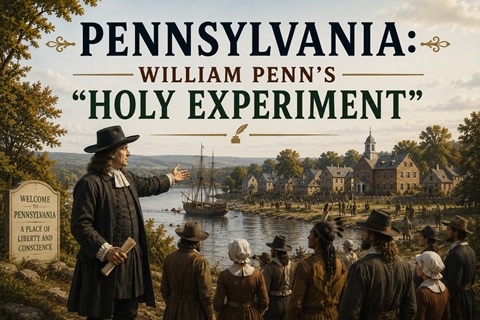
Overview
In 1681, King Charles II granted a large tract of land in North America to William Penn, a member of a religious group known as the Quakers. Penn envisioned Pennsylvania as a place where people could live in peace, practice their religion freely, and govern themselves fairly. He called his colony a “Holy Experiment” because he hoped to create a society based on tolerance, equality, and cooperation. Pennsylvania quickly became one of the most successful and diverse colonies in North America and played an important role in the development of Colonial America. This lesson follows the lesson plan outline provided in the uploaded document.
What You Will Learn
- Explain why William Penn founded Pennsylvania.
- Describe the principles behind Penn’s “Holy Experiment.”
- Understand how Pennsylvania became a successful and diverse colony.
Why William Penn Founded Pennsylvania
William Penn was a member of the Religious Society of Friends, commonly known as the Quakers. In England, Quakers faced discrimination because their beliefs differed from those of the Church of England. They refused to take religious oaths, believed that all people were equal before God, and challenged some traditional religious practices. As a result, many Quakers experienced fines, imprisonment, and other forms of persecution.
In 1681, King Charles II granted Penn land in North America to settle a debt owed to Penn’s father. Penn saw this opportunity as a chance to create a colony where people could enjoy religious freedom and fair treatment. He named the colony Pennsylvania, meaning “Penn’s Woods,” and encouraged settlers from many different backgrounds to make it their home.
The Principles of the “Holy Experiment”
Penn described Pennsylvania as a “Holy Experiment” because he wanted to prove that a society based on religious tolerance and cooperation could succeed. Unlike some colonies that enforced a single religion, Pennsylvania welcomed people of various faiths. Quakers, Lutherans, Mennonites, Catholics, Jews, and many others found opportunities to worship freely within the colony.
Penn also promoted fair government and peaceful relations with Indigenous peoples. He believed that laws should protect individual rights and that colonists should purchase land through agreements rather than simply taking it. Although challenges and disagreements still occurred, Pennsylvania became known for its commitment to tolerance and its efforts to create a more inclusive society than many other colonies of the time.
A Successful and Diverse Colony
Pennsylvania attracted thousands of settlers from across Europe. Fertile soil, religious freedom, and economic opportunity encouraged people to move to the colony. Farmers prospered by growing crops, while merchants benefited from expanding trade networks. The colony’s population grew rapidly, making it one of the largest and most prosperous in North America.
The city of Philadelphia became the colony’s most important center of commerce and government. Designed by William Penn, it featured wide streets and organized planning that reflected his vision for a well-ordered community. Because Pennsylvania welcomed people from many cultures and religions, it developed a diverse population that contributed to its economic growth and cultural richness.
Conclusion
William Penn founded Pennsylvania as a “Holy Experiment” to demonstrate that a colony based on religious freedom, tolerance, and fair government could thrive. His vision attracted settlers from many backgrounds and helped create one of the most successful colonies in North America. Pennsylvania’s commitment to diversity and individual rights influenced the development of Colonial America and later helped shape important American ideals.
Key Terms
- Quakers – Members of a Christian religious group that emphasized equality, peace, and individual faith.
- Religious Tolerance – The acceptance of people who hold different religious beliefs and practices.
Review Questions
- Why did William Penn establish the colony of Pennsylvania?
- What principles made Pennsylvania a “Holy Experiment”?
- How did religious freedom and economic opportunity contribute to Pennsylvania’s success?
Extension Activity
Design Your Own “Holy Experiment”
Objective
Create a plan for a new colony based on the principles of religious freedom, fairness, and cooperation inspired by William Penn’s vision for Pennsylvania.
Instructions
- Research the goals and beliefs that guided William Penn in founding Pennsylvania.
- Create a name, map, and flag for your colony.
- Develop a set of laws that promote religious tolerance and protect individual rights.
- Explain how your colony will govern itself and resolve disagreements among settlers.
- Describe how settlers will earn a living and interact with neighboring communities.
- Conclude with a written explanation of how your colony reflects the ideals of Penn’s “Holy Experiment” and whether you think it would succeed.
From Indigenous North America to European Colonization
Indigenous North America Before 1500
The European Age of Exploration
From Revolution to the Eve of Civil War
The Early Republic
The Jacksonian Era
Westward Expansion
The Late 19th Century
The American Civil War
Reconstruction
The Gilded Age
The Early 20th Century
The Progressive Era
World War I
The Roaring 20s and the Great Depression
Modern America Emerges
World War II
The Cold War
Post Cold War America
Modern America