The American Revolution is often told as the story of famous leaders—men like George Washington, Thomas Jefferson, and Benjamin Franklin. We picture soldiers in uniform, marching into battle, and dramatic moments like the signing of the Declaration of Independence.
But the Revolution was much bigger than that.
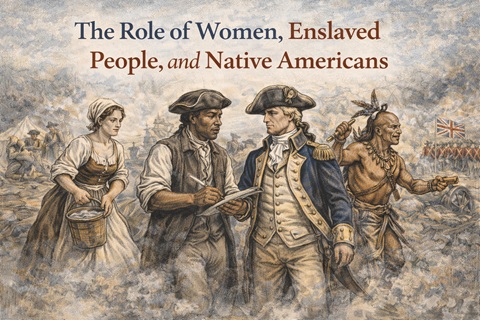
It involved thousands of ordinary people whose names are not always remembered. Among them were women, enslaved people, and Native Americans. Each group played important roles in the war, often facing difficult choices and great risks.
To truly understand the American Revolution, we must look at their stories too.
A War That Touched Everyone
When the war began in 1775, it did not just affect soldiers.
It affected:
- Families
- Farms
- Towns and villages
- Entire communities
People had to decide:
- Should they support independence?
- Should they remain loyal to Britain?
- Or should they try to stay out of the conflict?
For women, enslaved people, and Native Americans, these decisions were often especially complicated.
The Role of Women
At the time of the American Revolution, women did not have the same rights as men.
They could not:
- Vote
- Hold political office
- Serve as official soldiers
But that did not mean they were not involved.
In fact, women played many important roles—both on and off the battlefield.
Keeping Families and Farms Running
When men left home to fight, women took on new responsibilities.
They:
- Managed farms and businesses
- Cared for children and relatives
- Made important decisions about daily life
This was not easy.
Women had to work hard to keep their families and communities going during the war.
Supporting the War Effort
Women also helped support the army in many ways.
They:
- Made clothing and blankets for soldiers
- Cooked meals
- Collected supplies
Some even followed the army camps.
These women were sometimes called camp followers.
They washed clothes, cooked food, and helped care for soldiers.
Women on the Battlefield
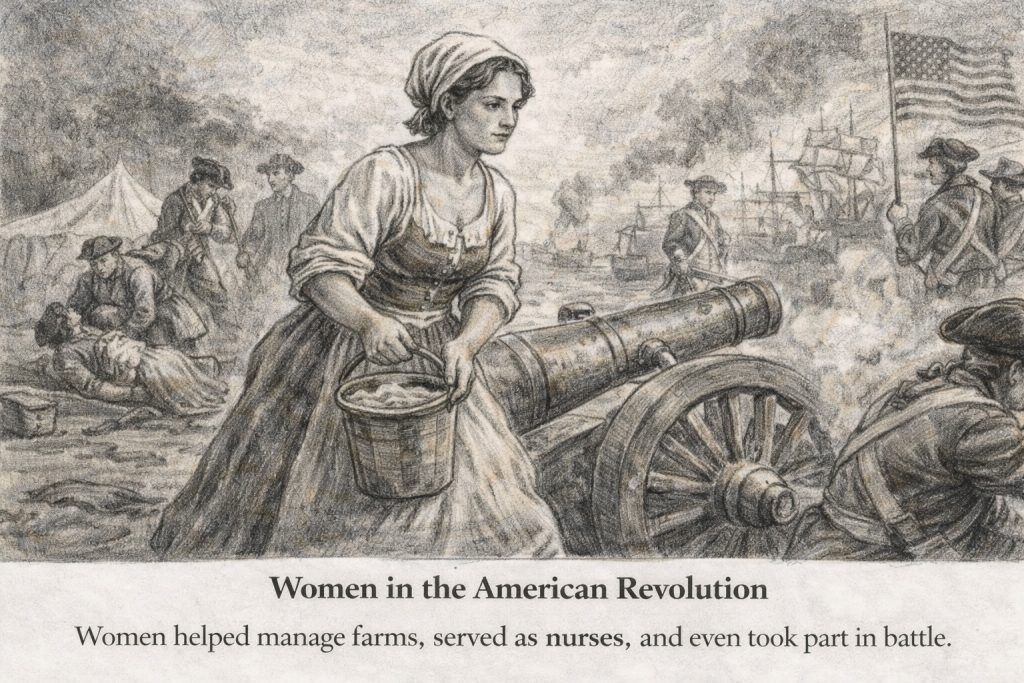
Although women were not officially soldiers, some were present during battles.
One famous example is Molly Pitcher.
Who was Molly Pitcher?
“Molly Pitcher” is a name used to describe women who carried water to soldiers during battle.
One woman often connected to this name is Mary Ludwig Hays.
What did she do?
During the Battle of Monmouth, she:
- Brought water to thirsty soldiers
- Helped cool down cannons
When her husband was injured, she even took his place at the cannon.
Spies and Messengers
Some women took on even more dangerous roles.
They became spies.
Why were spies important?
Spies gathered information about:
- Enemy plans
- Troop movements
- Supplies
This information could change the outcome of a battle.
An example: Agent 355
One mysterious figure was known as Agent 355.
She was part of a spy network that helped the American cause.
Although little is known about her, she played a role in uncovering British plans.
Voices for Freedom
Some women also began to speak out about rights and equality.
One important voice was Abigail Adams, the wife of John Adams.
What did she say?
In a famous letter, she urged her husband to:
“Remember the ladies.”
She believed that women deserved greater rights and protection.
The Limits Women Faced
Even though women contributed greatly to the war effort, they did not gain equal rights after the Revolution.
However, their actions showed that they were capable, strong, and essential to society.
The Role of Enslaved People
For enslaved people, the American Revolution was also a time of difficult choices.
They were not free, but the war offered new possibilities.
A Chance for Freedom
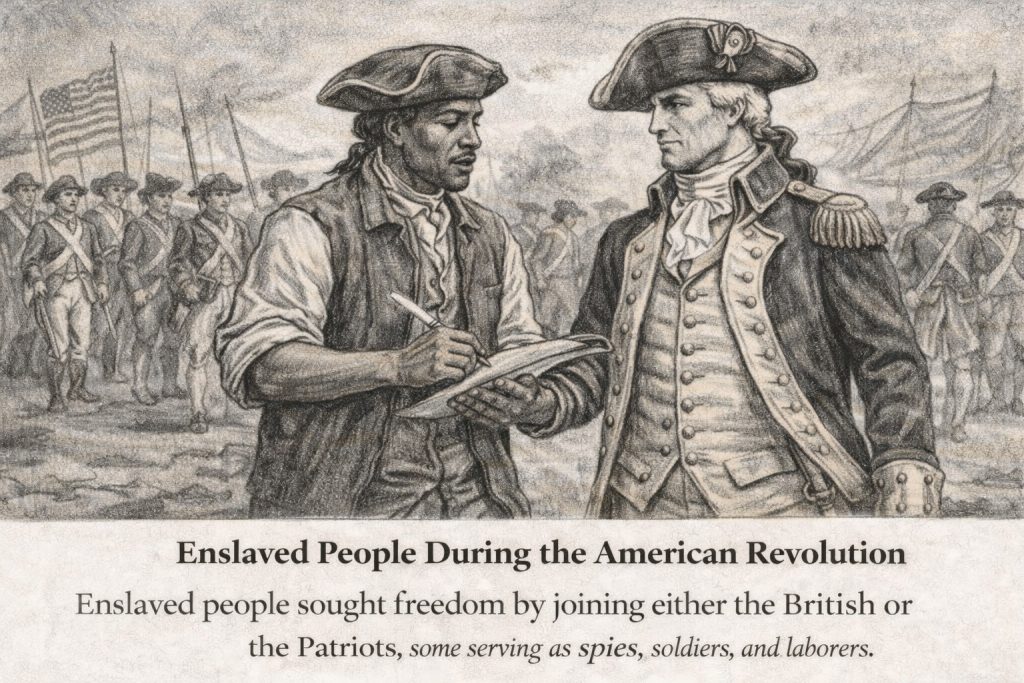
Both sides—British and American—sometimes offered freedom to enslaved people in exchange for their support.
The British offer
In 1775, the royal governor of Virginia, Lord Dunmore, made a proclamation.
He promised freedom to enslaved people who:
- Escaped from Patriot (colonial) owners
- Joined the British side
What happened next?
Thousands of enslaved people:
- Escaped
- Fled to British lines
- Hoped to gain their freedom
Fighting for the Patriots
Not all enslaved people joined the British.
Some fought for the American side.
Why would they do this?
Some were:
- Promised freedom
- Forced to serve
- Hoping to improve their situation
An example: James Armistead Lafayette
James Armistead was an enslaved man who became a spy for the Americans.
He:
- Pretended to work for the British
- Gathered important information
- Helped lead to the victory at Yorktown
After the war, he gained his freedom.
Harsh Realities
Despite these opportunities, many enslaved people did not gain freedom.
Some:
- Were captured and returned to slavery
- Were abandoned after helping the British
- Continued to live in bondage after the war
The Revolution did not end slavery.
A Growing Question
However, the ideas of the Revolution—freedom and equality—led some people to question slavery.
If all people were created equal, how could slavery continue?
This question would continue to grow in the years ahead.
The Role of Native Americans
For Native American tribes, the American Revolution was not just a war between colonies and Britain.
It was a struggle that directly affected their land and way of life.
A Difficult Choice
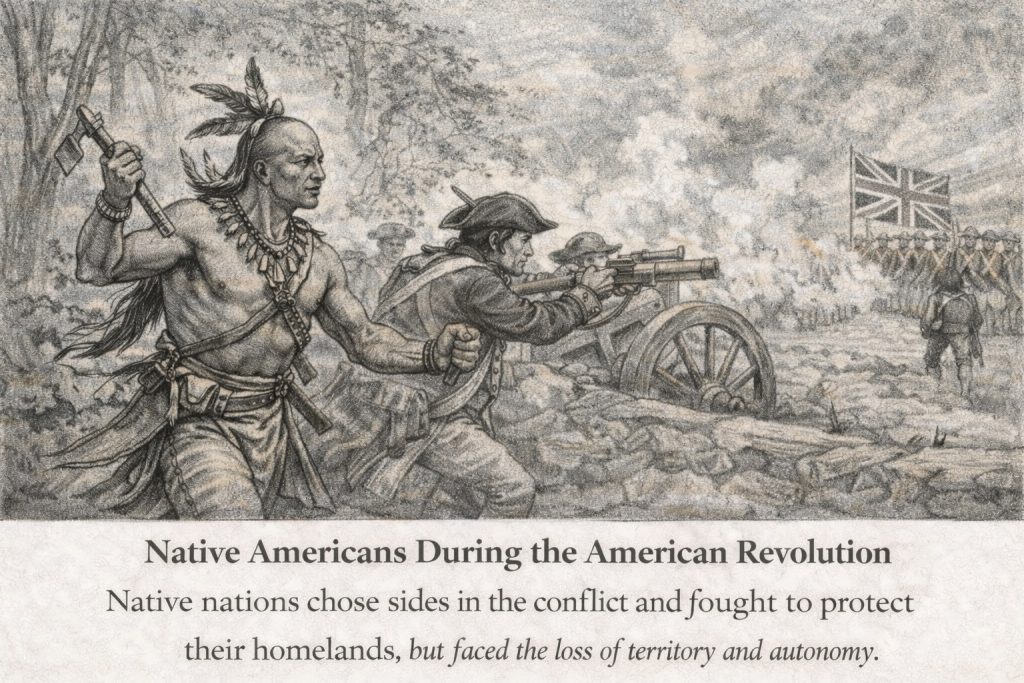
Many Native American tribes had to decide:
- Should they support the British?
- Should they support the Americans?
- Or should they try to stay neutral?
Why was this decision so hard?
Because both sides posed risks.
But many tribes believed that the British were more likely to:
- Limit colonial expansion
- Protect Native lands
Supporting the British
As a result, many Native American tribes chose to support the British.
Examples
Some of the tribes that supported the British included:
- The Mohawk
- The Cherokee
- Other members of the Iroquois Confederacy
A Divided Confederacy
Even within the Iroquois Confederacy, there was disagreement.
Some nations supported the British.
Others supported the Americans.
This led to division and conflict within the Confederacy itself.
Fighting on the Frontier
Much of the fighting involving Native Americans took place on the frontier.
These battles were often:
- Violent
- Personal
- Destructive
Homes and villages were attacked on both sides.
The Impact of the War
The Revolution had devastating effects on Native Americans.
After the war:
- The United States gained independence
- American settlers began expanding westward
What did this mean for Native Americans?
It often meant:
- Loss of land
- Broken treaties
- Continued conflict
Even tribes that had supported the Americans were not always protected.
A Struggle for Survival
For Native Americans, the Revolution was not just about independence.
It was about survival.
They were trying to protect:
- Their land
- Their culture
- Their future
Comparing the Experiences
Although women, enslaved people, and Native Americans had very different experiences, there are some important similarities.
Shared challenges
All three groups:
- Had limited power
- Faced difficult choices
- Took risks during the war
Contributions
Each group contributed in important ways:
- Women supported the war effort and even took part in battle
- Enslaved people fought, worked, and sought freedom
- Native Americans fought to protect their land and interests
Unequal outcomes
After the war, not all groups benefited equally.
- Women still lacked political rights
- Many enslaved people remained enslaved
- Native Americans lost land and power
The Meaning of the Revolution
The American Revolution was about ideas like:
- Freedom
- Equality
- Rights
But these ideas were not fully applied to everyone at the time.
Why does this matter?
Because it reminds us that history is complex.
The Revolution created new opportunities—but also left many questions unanswered.
A Final Thought
When we think about the American Revolution, we should remember that it was not just fought by famous leaders or soldiers.
It was shaped by:
- Women who kept families and armies going
- Enslaved people who risked everything for freedom
- Native Americans who fought to protect their land
Their stories are an essential part of history.
Conclusion
The American Revolution was a time of change, struggle, and hope.
Women, enslaved people, and Native Americans all played important roles in this conflict, even though their contributions are sometimes overlooked.
By learning about their experiences, we gain a deeper understanding of the Revolution—and of the challenges and possibilities it created.
Their stories remind us that history belongs to everyone.
Reflection Questions
- How did women contribute to the American Revolution?
- Why did some enslaved people choose to join the British?
- What challenges did Native Americans face during the war?
- Why did the Revolution not bring equal rights to everyone?
