Imagine starting a brand-new community from scratch.
There are no roads, no schools, no stores, and no government buildings—just forests, rivers, and open land. Now imagine that your goal is not just to survive, but to build a perfect society—one that follows your deepest beliefs about how people should live.
That is exactly what the Puritans hoped to do when they came to America in the early 1600s.
Their colony, known as the Massachusetts Bay Colony, became one of the most important settlements in early American history. It was a place shaped by strong religious beliefs, strict rules, growing towns, and a commitment to education.
But it was also a place of challenges, disagreements, and difficult decisions.
Let’s explore who the Puritans were, what they believed, how they built their colony, and why their story still matters today.
Who Were the Puritans?
The Puritans were a group of English Protestants who believed that the Church of England needed to be “purified.”
They thought the church still had too many practices from the Catholic Church, which they believed were wrong. Unlike the Pilgrims (who wanted to separate completely), the Puritans wanted to reform the church from within.
However, their ideas were not popular with everyone.
In England, the king and government supported the Church of England. People who challenged it could face punishment, including fines or imprisonment.
Because of this, many Puritans felt they could not live freely according to their beliefs.
So, like the Pilgrims before them, they made a bold decision:
They would leave England and build a new society in America.
The Journey to Massachusetts Bay
In 1630, a large group of Puritans set sail for North America.
Unlike the Pilgrims, who came in a small group, the Puritans arrived in much larger numbers. Over time, thousands of Puritans migrated to New England in what is sometimes called the Great Migration.
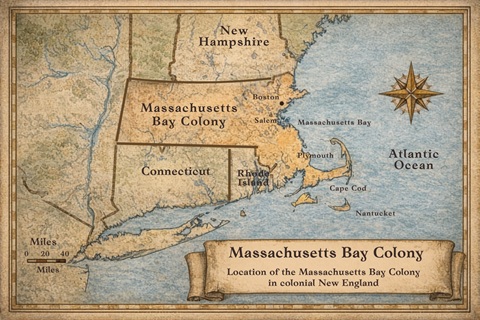
They settled in an area north of Plymouth, creating the Massachusetts Bay Colony.
Their goal was not just to survive—they wanted to build a model society.
“A City upon a Hill”
One of the most famous ideas connected to the Puritans comes from a leader named John Winthrop.
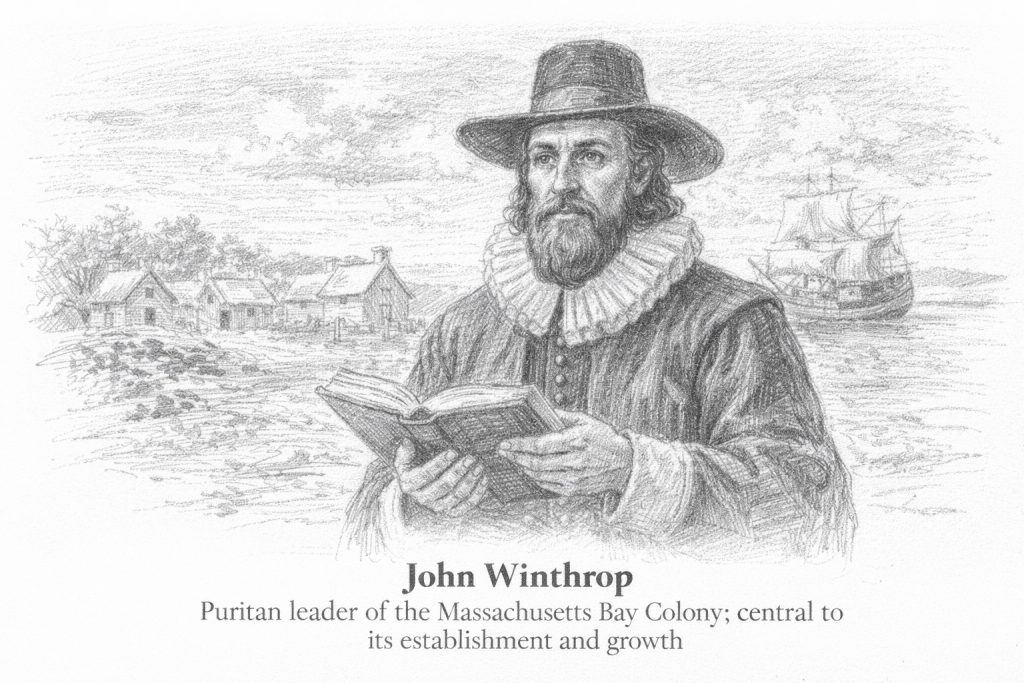
Before arriving in America, Winthrop gave a speech in which he said their colony should be like a “City upon a Hill.”
What did he mean?
He believed that:
- Their community should be an example for others
- People everywhere would be watching them
- They had a responsibility to live in a moral and religious way
If they succeeded, they would show the world how to live correctly.
If they failed, it would be a warning.
This idea helped shape how the Puritans saw themselves. They believed they had an important mission.
Building a Strict Religious Society
Religion was at the center of Puritan life.
Their colony was not just a place to live—it was a religious community.
Church and Government
In Massachusetts Bay, church and government were closely connected.
- Only male church members could vote
- Laws were based on religious beliefs
- Leaders were expected to follow Puritan values
This meant that religion influenced nearly every part of life.
Daily Life and Rules
The Puritans believed in hard work, discipline, and order.
Their daily lives included:
- Attending long church services
- Reading the Bible
- Following strict rules about behavior
They discouraged activities they saw as sinful, such as:
- Excessive drinking
- Gambling
- Skipping church
Even clothing was expected to be simple and modest.
A Community of Watchful Neighbors
Puritan communities were close-knit.
People kept an eye on one another to make sure everyone followed the rules. This was not just about control—it was about maintaining what they believed was a good and moral society.
If someone broke the rules, they could face punishment, such as fines or public embarrassment.
But What About Freedom?
Here is an interesting and important point:
The Puritans came to America seeking religious freedom—but they did not always allow freedom for others.
If someone disagreed with Puritan beliefs, they could be punished or even forced to leave the colony.
This shows a key idea in history:
People can want freedom for themselves but struggle to give it to others.
Key Leaders of Massachusetts Bay
Several important leaders helped shape the Massachusetts Bay Colony.
John Winthrop: The Guiding Voice
John Winthrop was the first governor of the colony and one of its most important leaders.
He believed strongly in the idea of a “City upon a Hill” and worked to guide the colony according to Puritan values.
He also helped establish a system of government where leaders were chosen by members of the community (though only certain people could participate).
John Cotton: A Religious Leader
John Cotton was a powerful minister in the colony.
He helped shape the religious life of the Puritans and influenced how the church and government worked together.
His teachings reinforced the importance of following strict religious rules.
Anne Hutchinson: A Voice of Challenge
Not everyone agreed with Puritan leaders.
Anne Hutchinson was a woman who began holding meetings in her home, where she shared her own religious ideas.
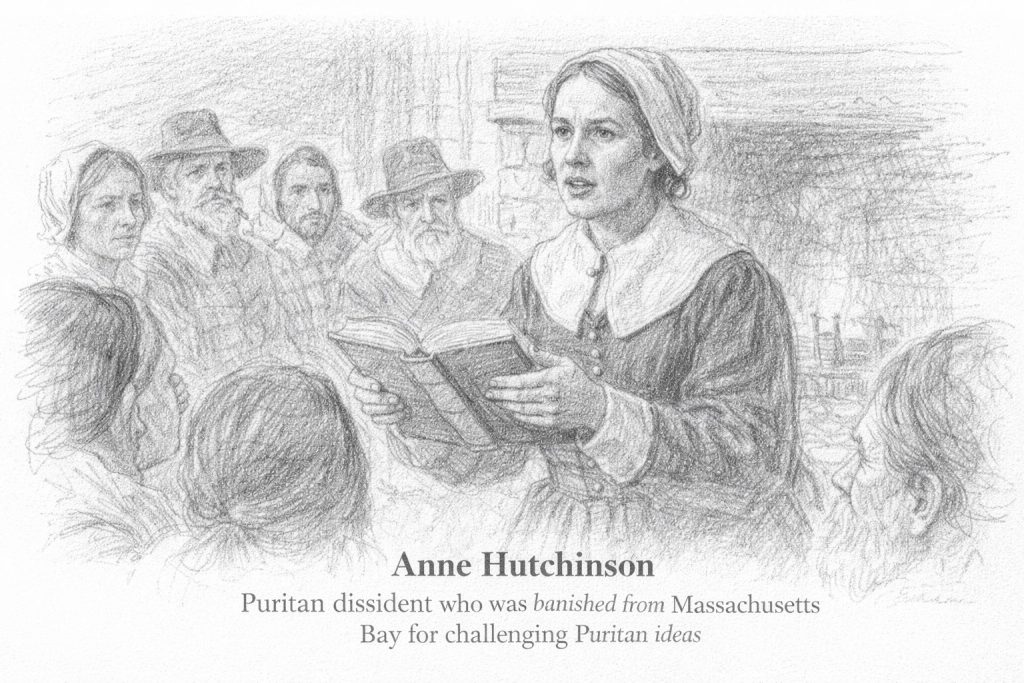
She believed that individuals could have a direct relationship with God and did not always need church leaders to guide them.
This challenged the authority of the colony’s leaders.
As a result, she was put on trial and eventually banished (forced to leave the colony).
Her story is important because it shows how disagreement was handled—and how limited freedom of expression could be.
Roger Williams: A Different Vision
Roger Williams was another important figure who disagreed with Puritan leaders.
He believed in:
- Separation of church and government
- Fair treatment of Native Americans
- Religious freedom for all
Because of his views, he was also banished from Massachusetts Bay.
He later founded the colony of Rhode Island, which became known for its religious tolerance.
Growth of Towns
As more Puritans arrived, the Massachusetts Bay Colony grew quickly.
Instead of one large settlement, they created many small towns.
How Towns Were Organized
Each town usually included:
- A meetinghouse (used for church and town meetings)
- Homes and farms
- Common land for grazing animals
Towns were often designed so that people lived close together, making it easier to attend church and support one another.
Town Meetings
Puritans developed a system of local government called the town meeting.
In these meetings, male property owners could:
- Discuss issues
- Vote on decisions
- Help govern their community
This was an early form of democratic participation, though it did not include everyone.
The Importance of Education
One of the most important contributions of the Puritans was their focus on education.
Why Education Mattered
The Puritans believed that everyone should be able to read the Bible.
This meant that children needed to learn how to read.
Education was not just about knowledge—it was about religion and understanding God’s word.
Schools and Laws
The Puritans established some of the first schools in the colonies.
In 1647, Massachusetts passed a law often called the “Old Deluder Satan Act.”
It required towns to:
- Hire teachers
- Provide schooling for children
The idea was that if people could read, they would not be “tricked” by false ideas.
Harvard College
In 1636, the Puritans founded Harvard College.
Its main purpose was to train ministers and educated leaders for the colony.
This shows how seriously they took education and leadership.
Challenges and Conflicts
Even though the Puritans had a clear vision, life in Massachusetts Bay was not always easy.
Harsh Conditions
Like other colonies, they faced:
- Cold winters
- Disease
- Food shortages
Survival required hard work and cooperation.
Conflicts with Native Americans
As the colony expanded, tensions grew with Native Americans.
Puritans needed more land for farms and towns. This often led to conflict.
One major conflict was the Pequot War (1636–1637), which was violent and deadly.
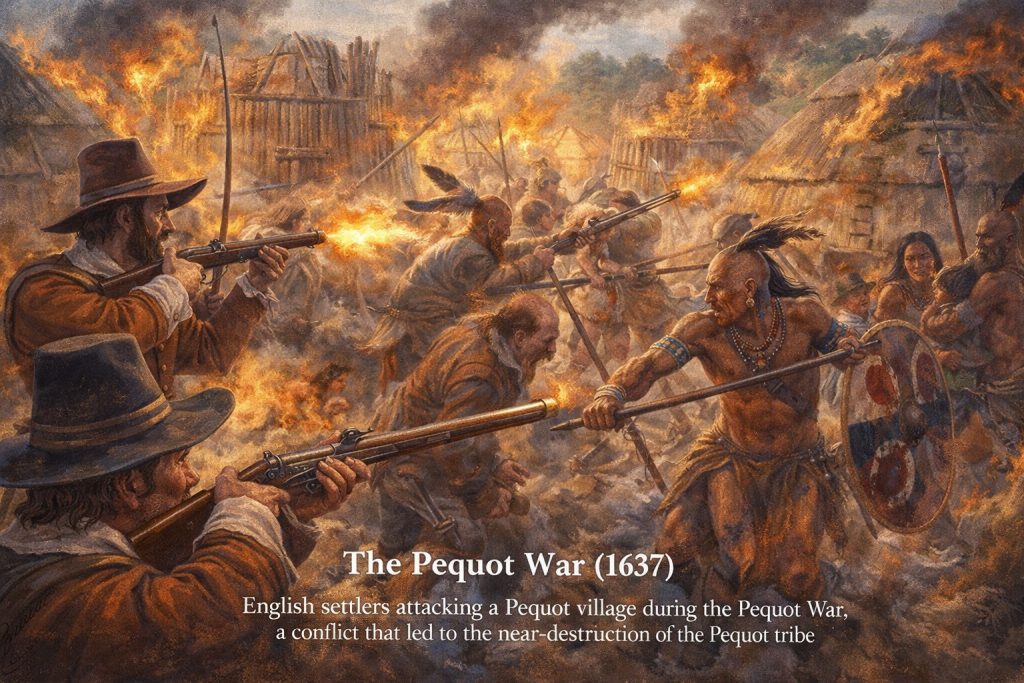
These conflicts remind us that the growth of the colonies often came at a great cost to Native American communities.
Internal Disagreements
Not all Puritans agreed with one another.
Disagreements over religion and leadership led to:
- Trials
- Banishments
- The founding of new colonies
This shows that even in a community with shared beliefs, conflict can still occur.
A Lasting Influence
The Massachusetts Bay Colony had a lasting impact on American history.
Ideas About Government
The Puritans helped develop ideas about:
- Self-government
- Community decision-making
- Local participation
These ideas would later influence the development of American democracy.
Education and Literacy
Their focus on education helped create a tradition of learning that continues today.
Public education and the importance of reading can be traced, in part, to Puritan beliefs.
The “City upon a Hill” Idea
John Winthrop’s idea of a “City upon a Hill” has been remembered for centuries.
It has been used by leaders to describe the idea that America should be a model for others.
Thinking About the Puritans
The Puritans were not simple heroes or villains.
They were complex people with strong beliefs.
They:
- Sought religious freedom
- Built organized communities
- Valued education and hard work
But they also:
- Enforced strict rules
- Limited freedom for others
- Took land that Native Americans had lived on for generations
Understanding both sides of their story helps us better understand history.
What Can We Learn?
The story of the Puritans and Massachusetts Bay teaches us several important lessons:
- Ideas matter. Beliefs can shape entire communities.
- Freedom is complicated. It is not always applied equally.
- Communities require cooperation. People must work together to succeed.
- History has many perspectives. Different people experience events in different ways.
Final Thought
Imagine again that you are part of the Puritan journey.
You leave your home, cross an ocean, and help build a new society from the ground up.
Would you
- follow strict rules for the good of the community?
- speak out if you disagreed?
- stay—or leave to start something new?
The Puritans faced these questions every day.
Their answers shaped the Massachusetts Bay Colony—and helped shape the early history of America.
And their story reminds us that building a society is never simple. It is a challenge filled with hopes, struggles, and important choices.
