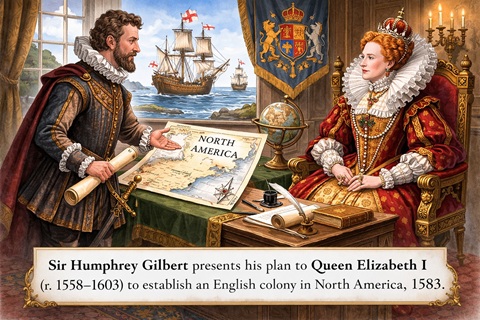
In the late 1500s, England was beginning to look beyond its own shores. Other European countries, especially Spain and Portugal, had already built empires in the New World. They had discovered lands, claimed territories, and begun to grow wealthy from trade and resources. England, however, was still trying to find its place in this new age of exploration.
One of the first Englishmen to imagine a true English empire in North America was Sir Humphrey Gilbert. He was not just an explorer—he was a dreamer, a planner, and a man determined to turn England into a world power. His efforts led to one of the earliest attempts by England to claim and colonize land in North America. Although his story ended in tragedy, his ideas helped shape the future of English colonization.
A New Idea: Colonies in the New World
Before Gilbert’s time, most exploration had focused on finding trade routes—especially routes to Asia. Explorers like John Cabot and Martin Frobisher had searched for ways to reach the riches of the East. But Gilbert had a different vision.
He believed that England should not just explore new lands—it should settle them.
A colony is a place where people from one country move to another land and build communities there. These settlers remain connected to their home country, which controls the colony. Spain had already established colonies in the Americas, and these colonies were bringing great wealth.
Gilbert believed England could do the same.
He argued that colonies could help England in several ways:
- They could provide new resources, such as fish, timber, and minerals
- They could create new markets for English goods
- They could give England more power and influence in the world
- They could offer new opportunities for people in England
At the time, this was a bold and somewhat risky idea. England had never successfully established a colony in North America. But Gilbert was determined to try.
Who Was Sir Humphrey Gilbert?
Sir Humphrey Gilbert was born around 1539 in England. He came from a well-connected family and received a good education. He studied subjects like mathematics and navigation, which were important for exploration.
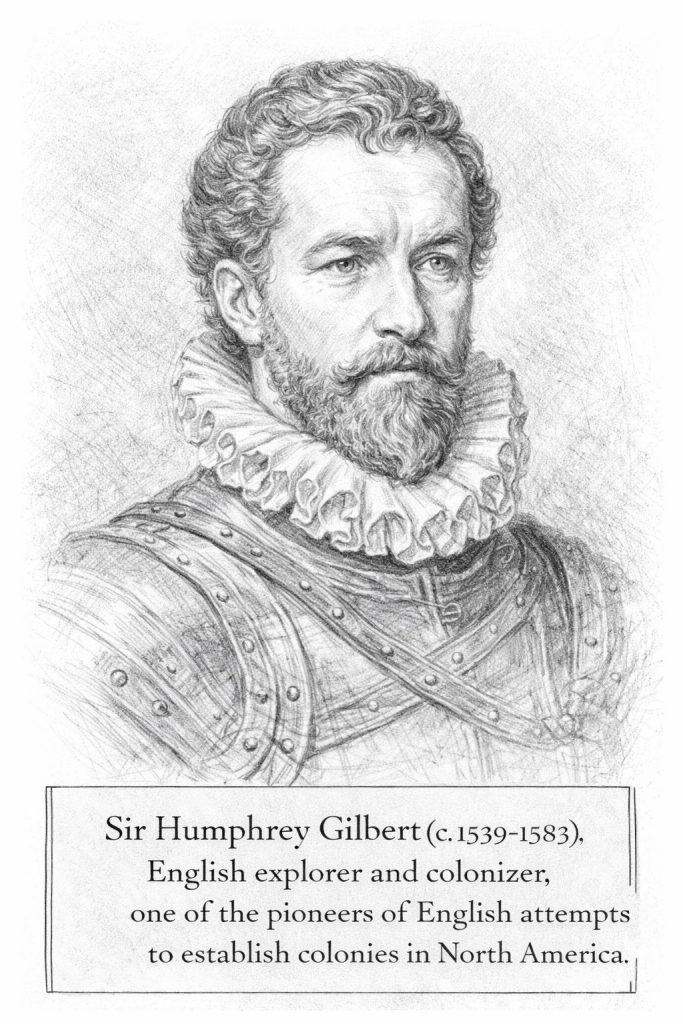
Gilbert was also a soldier and a writer. He fought in wars and wrote about his ideas for exploration and colonization. One of his most important writings argued that England should create colonies in North America.
He was also the half-brother of another famous explorer, Walter Raleigh. Like Gilbert, Raleigh would later play a key role in England’s efforts to settle the New World.
Gilbert was known for being bold and determined, but also stubborn. He believed strongly in his ideas and was willing to take great risks to achieve them.
Permission from the Queen
In order to start a colony, Gilbert needed permission from the English monarch, Queen Elizabeth I.
In 1578, Queen Elizabeth granted Gilbert a special document called a charter. This charter gave him the right to explore and claim lands in North America that were not already controlled by other European powers.
The charter was important because it made Gilbert’s mission official. It also meant that any land he claimed would belong to England.
However, the charter came with a challenge: Gilbert had to organize and pay for the expedition himself, with help from investors. This meant he had to gather ships, supplies, and settlers—all without direct funding from the government.
Early Attempts and Challenges
Gilbert’s first attempts to launch an expedition did not go well. His early voyages faced problems such as:
- Lack of funding
- Poor planning
- Dangerous weather
- Conflicts among crew members
At one point, his expedition had to turn back before even reaching North America.
These failures might have discouraged many people, but Gilbert did not give up. He continued to plan and prepare for another attempt.
The Voyage of 1583
In 1583, Gilbert finally launched his most important expedition. He set sail with a small fleet of ships, including one called the Squirrel, which was quite small for such a long and dangerous journey.
The voyage across the Atlantic was difficult. The ships faced storms and rough seas, and not all of them stayed together. Despite these challenges, Gilbert and his crew eventually reached the coast of North America.
Their destination was the island of Newfoundland, located off the eastern coast of present-day Canada.
Claiming Newfoundland
When Gilbert arrived in Newfoundland, he did something very important. He formally claimed the land for England.
This act took place in August 1583 at a harbor now known as St. John’s. Gilbert gathered his crew and declared that the land belonged to England under the authority of Queen Elizabeth I.
This was a significant moment in history. It marked one of England’s earliest official claims in North America.
Gilbert also took steps to establish English authority in the area:
- He claimed the land in the queen’s name
- He announced that English laws would apply there
- He attempted to organize the region as an English colony
Although there were already fishermen from different countries in Newfoundland, Gilbert’s claim made it clear that England intended to control the territory.
A Vision of Colonization
Gilbert’s actions in Newfoundland were part of a larger vision. He did not just want to claim land—he wanted to create permanent English settlements.
He imagined colonies where English people could live, work, and build communities. These colonies would serve as bases for trade, fishing, and further exploration.
However, turning this vision into reality was not easy.
The environment in Newfoundland was harsh. The weather was cold, the land was rugged, and supplies were limited. Establishing a colony required careful planning, strong leadership, and reliable support—all of which were difficult to maintain.
Despite these challenges, Gilbert’s efforts laid the groundwork for future attempts at colonization.
The Return Voyage
After claiming Newfoundland, Gilbert decided to return to England. The expedition had faced many difficulties, and it was clear that more planning would be needed to establish a lasting colony.
The journey home, however, would prove to be even more dangerous than the voyage out.
Gilbert chose to sail in the Squirrel, the smallest ship in the fleet. This decision worried his crew, as the ship was not well-suited for crossing the Atlantic.
As the ships made their way back, they encountered severe storms. Waves crashed against the ships, and strong winds made navigation difficult.
The Death of Sir Humphrey Gilbert
During the return voyage, Gilbert’s ship was caught in a powerful storm. The Squirrel struggled to stay afloat in the rough seas.
According to reports, Gilbert remained calm and determined, even as danger surrounded him. He was seen sitting on deck, reading a book, and reportedly said, “We are as near to heaven by sea as by land.”
Soon after, the Squirrel disappeared into the storm and was lost at sea. Gilbert and his crew were never seen again.
His death marked a tragic end to his bold attempt to establish England’s first colony in North America.
Why Gilbert’s Efforts Matter
Even though Gilbert did not succeed in building a lasting colony, his efforts were still very important.
1. England’s First Step Toward Colonization
Gilbert’s claim of Newfoundland was one of the earliest official English claims in North America. It showed that England was serious about establishing a presence in the New World.
2. A New Way of Thinking
Before Gilbert, exploration was mostly about finding routes and resources. Gilbert introduced the idea that England should create permanent settlements.
3. Inspiration for Future Explorers
Gilbert’s vision did not die with him. His half-brother, Walter Raleigh, would continue his work. Raleigh later sponsored attempts to establish colonies, including the famous Roanoke colony.
The Challenges of Colonization
Gilbert’s story also helps us understand how difficult colonization was.
Starting a colony required:
- Ships and supplies
- Skilled leaders and workers
- Cooperation among settlers
- The ability to survive in unfamiliar environments
It also involved interactions with Indigenous peoples, who had lived in these lands for thousands of years. These encounters were often complex and sometimes led to conflict.
Gilbert’s failed attempt shows that colonization was not easy or guaranteed to succeed.
The Bigger Historical Impact
Over time, England would continue to pursue Gilbert’s vision. In the early 1600s, English settlers established permanent colonies such as Jamestown and Plymouth.
These colonies grew and developed into larger settlements. Eventually, they became part of what would become the United States and Canada.
Gilbert did not live to see this future, but his ideas played a role in making it possible.
Conclusion
Sir Humphrey Gilbert was a man ahead of his time. He believed that England should do more than explore—it should build a new world across the ocean.
In 1583, he claimed Newfoundland for England, marking one of the country’s earliest steps toward colonization. Although his attempt to establish a colony did not succeed, his vision helped shape the future of English expansion.
His life ended tragically at sea, but his ideas lived on. They inspired future explorers and settlers who would continue the work he began.
For students of history, Gilbert’s story is a powerful reminder that big ideas often begin with bold individuals. Even when those individuals do not succeed, their efforts can change the course of history.
Sir Humphrey Gilbert’s dream of English colonies in North America was only the beginning—but it was an important beginning that helped shape the world we know today.
