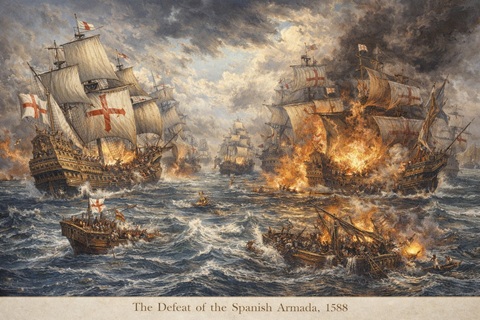
In the year 1588, one of the most important events in world history took place on the waters off the coast of England. A massive fleet of ships known as the Spanish Armada sailed toward England with the goal of invading the country. Spain was the most powerful nation in Europe at the time, and many believed its victory was certain.
But something surprising happened.
England, a smaller and less powerful nation, defeated the Armada. This victory changed history. It marked the beginning of England’s rise as a major sea power and helped open the Atlantic Ocean to English ships.
To understand why this moment was so important, we need to look at the people involved, the reasons behind the conflict, and what happened during the battle.
Two Powerful Rulers: Philip II vs Elizabeth I
At the center of this story are two rulers:
- King Philip II of Spain
- Queen Elizabeth I of England
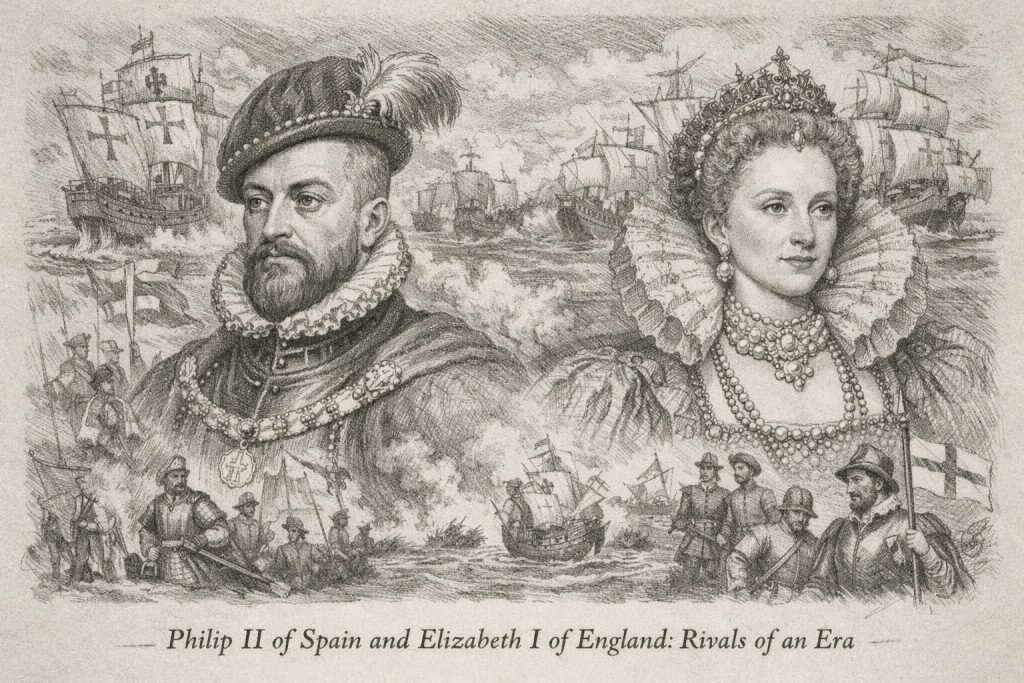
These two leaders represented not only different countries but also different beliefs and goals.
King Philip II of Spain
Philip II ruled Spain during its most powerful years. Spain had:
- A vast empire in the Americas
- Huge amounts of gold and silver
- A strong army and navy
- A deep commitment to the Catholic Church
Philip believed it was his duty to defend Catholicism and expand Spain’s power.
Queen Elizabeth I of England
Elizabeth I ruled England during a time of change. England had:
- Become a Protestant nation
- A growing but smaller navy
- A desire to compete with Spain
Elizabeth supported exploration and allowed English sailors to challenge Spanish ships, even if it sometimes led to conflict.
Why Did Spain Send the Armada?
Spain did not send the Armada without reason. Several important factors led to this decision.
1. Religious Conflict
Spain was Catholic, while England was Protestant. Philip II wanted to return England to Catholic rule. He believed that defeating Elizabeth would help achieve this goal.
2. English Attacks on Spanish Ships
English privateers, such as Sir Francis Drake, attacked Spanish ships carrying treasure from the Americas. These attacks angered Philip and hurt Spain’s economy.
3. Support for Spain’s Enemies
England supported the Dutch rebels in the Netherlands, who were fighting against Spanish rule. This made Spain even more determined to act against England.
4. A Plan to Invade England
Philip II created a plan:
- The Spanish Armada would sail to the English Channel
- It would meet Spanish soldiers waiting in the Netherlands
- Together, they would invade England
If successful, this plan would remove Elizabeth from power and make England Catholic again.
The Spanish Armada Sets Sail
In 1588, the Spanish Armada—about 130 ships—set sail from Spain. It was one of the largest fleets ever assembled.
The ships were:
- Large and heavily armed
- Filled with soldiers and supplies
- Designed for boarding enemy ships in close combat
Many people believed the Armada was unstoppable.
The English Navy Prepares
England’s navy was smaller but different in important ways.
English ships were:
- Faster and more maneuverable
- Equipped with long-range cannons
- Designed for hit-and-run attacks rather than close combat
English commanders, including Sir Francis Drake, used new tactics that would prove very important.
Why the Spanish Armada Failed
Despite its size and strength, the Spanish Armada failed. Several key reasons explain why.
1. English Naval Tactics
The English avoided close combat. Instead, they:
- Stayed at a distance
- Fired cannons repeatedly
- Damaged Spanish ships without being boarded
This strategy worked well against the larger Spanish ships.
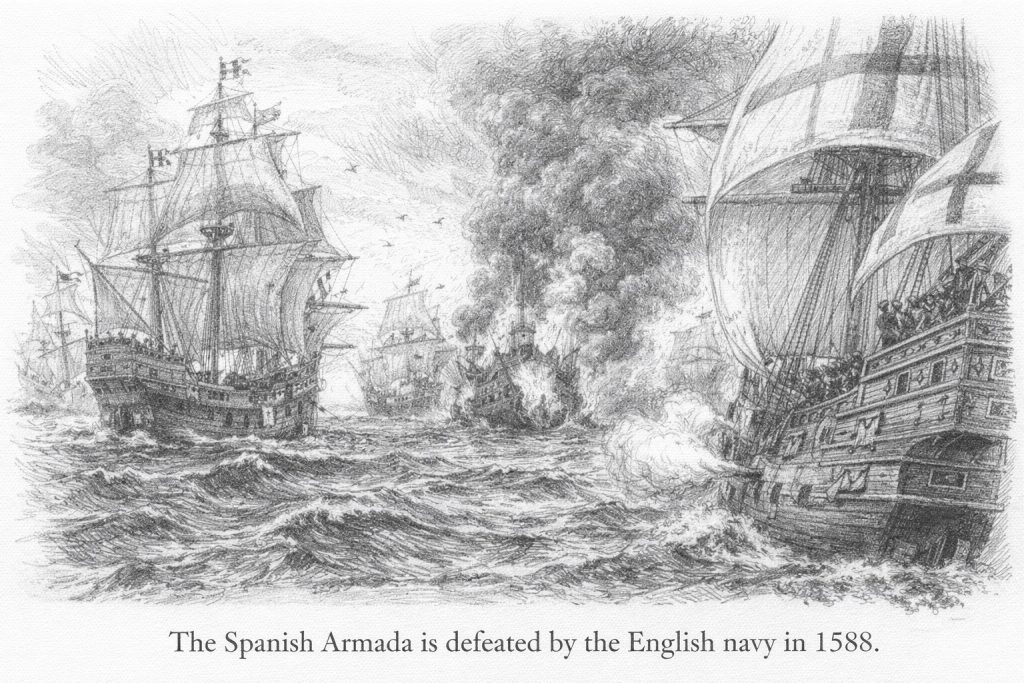
2. Fireships at Calais
One of the most dramatic moments occurred near the French port of Calais.
The English sent fireships—ships filled with burning materials—toward the Spanish fleet at night.
The Spanish ships panicked:
- They cut their anchors to escape
- Their formation was broken
- Ships were scattered
This made the Spanish fleet easier to attack.
3. Strong Winds and Storms
After the battle, the Spanish fleet tried to sail around Scotland and return home. But powerful storms struck.
These storms:
- Wrecked many ships
- Drove others onto rocky shores
- Caused great loss of life
The Spanish later called this “the Protestant Wind,” believing it helped England.
4. Problems with Communication and Planning
The Spanish plan required careful timing and coordination. But:
- The Armada failed to link up with the army in the Netherlands
- Communication was slow and difficult
- Plans fell apart under pressure
Without a successful meeting with the army, the invasion could not happen.
The Result: A Stunning English Victory
The defeat of the Spanish Armada shocked Europe.
Spain, once seen as unbeatable, had lost.
England, once considered weaker, had proven its strength.
This victory had several important effects.
How England Gained Naval Confidence
Before 1588, England was not the leading naval power. After the Armada, everything changed.
A New Sense of Confidence
The victory gave England confidence in its navy and its sailors.
English leaders realized:
- Their ships and tactics were effective
- They could defeat a stronger opponent
- They belonged among the great powers
Growth of the Navy
England began to invest more in its navy.
- More ships were built
- Better weapons were developed
- Skilled sailors gained experience
Over time, England’s navy became one of the strongest in the world.
National Pride
The victory became a symbol of national pride. It showed that England could defend itself and stand up to powerful enemies.
Opening of the Atlantic to English Ships
One of the most important results of the Armada’s defeat was the opening of the Atlantic Ocean to English exploration and trade.
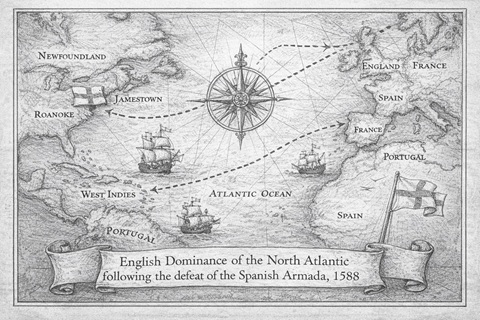
Breaking Spain’s Control
Before 1588, Spain dominated the Atlantic:
- Spanish ships carried treasure from the Americas
- Spain controlled many key routes
- Other nations were cautious about challenging Spanish power
After the Armada’s defeat, Spain’s control weakened.
English Exploration Expands
England began to explore more actively:
- Ships sailed to North America
- New trade routes were developed
- Colonies began to be established
Although early colonies struggled, these efforts laid the foundation for future success.
Trade and Opportunity
The Atlantic became a place of opportunity for England:
- Trade with the Americas increased
- New goods and resources became available
- English merchants and sailors grew wealthier
This helped England grow stronger economically.
A Turning Point in History
The defeat of the Spanish Armada in 1588 was more than just a naval battle—it was a turning point.
Decline of Spanish Dominance
Spain remained powerful, but its image of invincibility was broken.
Other nations began to challenge Spain more openly.
Rise of England
England’s rise as a naval power began in earnest. Over time, it would build a global empire.
A New Era of Exploration
The Atlantic Ocean became a shared space where multiple nations explored, traded, and competed.
Conclusion
The story of the Spanish Armada is a story of rivalry, courage, and change.
King Philip II of Spain sought to defeat England and strengthen his empire. Queen Elizabeth I stood firm, supporting her navy and her people. When the Armada sailed in 1588, it seemed that Spain would win.
But through clever tactics, determination, and even the power of nature, England achieved a surprising victory.
This victory gave England confidence, opened new opportunities, and marked the beginning of its rise as a great sea power. It allowed English ships to sail more freely across the Atlantic and laid the groundwork for future exploration and colonization.
Understanding this event helps us see how a single moment can change the course of history. The defeat of the Spanish Armada did just that—it helped shape the modern world and set England on a path toward global influence.
