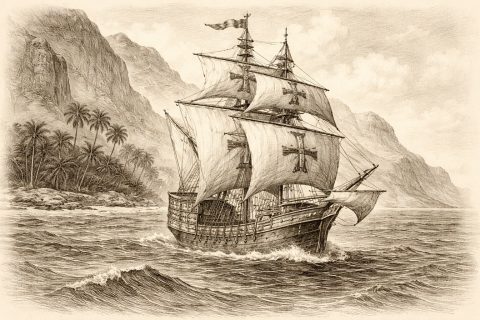
A Journey to the Edge of the Known World
In the late 1400s, European explorers were slowly pushing the boundaries of what they knew about the world. For decades, Portuguese sailors had been exploring the west coast of Africa. Voyage by voyage, they sailed a little farther south, mapping coastlines, trading with local peoples, and searching for a sea route to Asia.
Why Asia? Because Asia was home to valuable goods like spices, silk, and precious stones. These goods were in high demand in Europe, but they were expensive because they had to travel over long and dangerous land routes. Portuguese leaders believed that if they could find a direct sea route to Asia, they could trade more easily and become very wealthy.
By the 1480s, Portuguese exploration had reached deep into southern Africa—but one major question remained unanswered:
Could ships sail around the southern tip of Africa and reach the Indian Ocean?
The man who would help answer that question was Bartolomeu Dias.
His journey would become one of the most important turning points in the history of exploration.
Portugal’s Long Effort to Reach the East
Before we understand Dias’s voyage, it is important to see how it fit into a larger story.
For many years, Portugal had been leading European exploration. Inspired by earlier efforts under Prince Henry the Navigator, Portuguese sailors had developed better ships, stronger navigation tools, and more accurate maps.
They used a careful method:
- Explore a little farther each time
- Record what they discovered
- Return safely and plan the next voyage
By the time Dias set sail, explorers had already reached as far south as present-day Namibia and parts of South Africa. But no one had yet sailed around the southern tip of the continent.
Many sailors wondered:
- Would the ocean currents make it impossible?
- Would storms destroy ships?
- Did Africa stretch endlessly to the south?
These were not small questions. The answers would determine whether a sea route to Asia was even possible.
Who Was Bartolomeu Dias?
Bartolomeu Dias was a Portuguese nobleman and experienced sailor. Although we do not know everything about his early life, we know that he was trusted by the Portuguese king, King John II, to lead an important expedition.
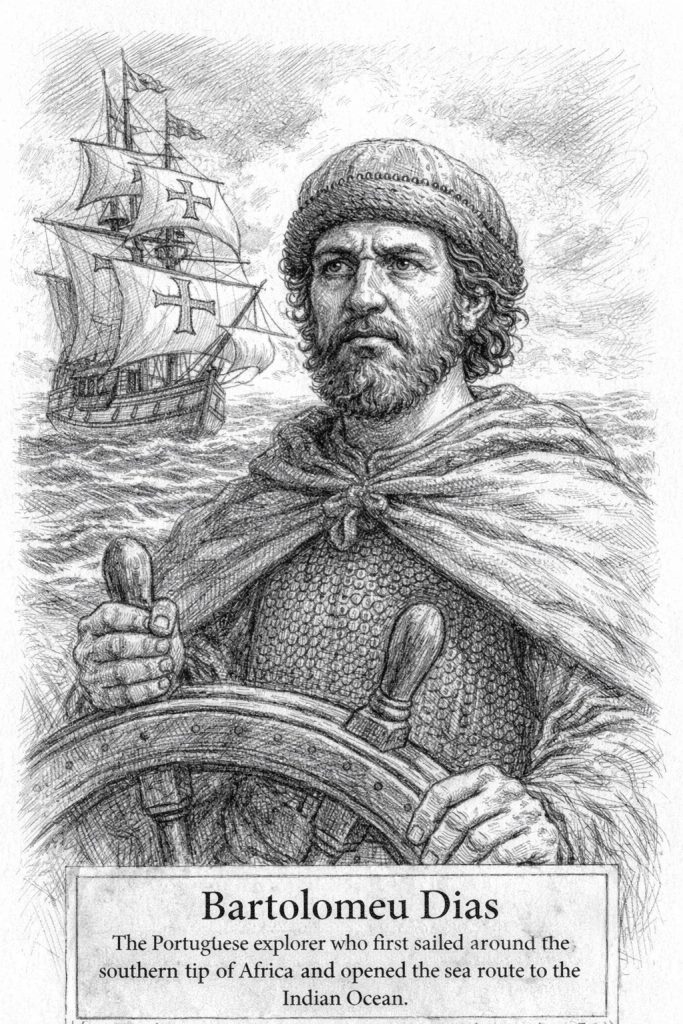
Dias was chosen for a difficult mission:
- Sail farther south than any European had gone before
- Find the southern end of Africa
- Discover whether it was possible to reach the Indian Ocean
This was a dangerous assignment. No one knew what lay ahead.
Setting Sail into the Unknown
In 1487, Dias set sail from Portugal with a small fleet of ships. His expedition likely included:
- Two caravels (fast, maneuverable ships)
- One supply ship carrying extra food and equipment
The ships followed the familiar route down the west coast of Africa. At first, the journey was similar to earlier voyages. They stopped along the coast, gathered supplies, and continued south.
But as they sailed farther than any explorers before them, conditions became more difficult.
Into the Storms of the South Atlantic
As Dias approached the southern part of Africa, his expedition encountered something new and frightening: powerful storms.
These storms were unlike anything sailors had experienced before. Strong winds pushed the ships far out into the open ocean. Huge waves battered them for days.
At one point, Dias and his crew were driven so far south and east that they lost sight of land entirely.
For many days, they sailed through rough seas without knowing where they were.
This was a terrifying experience. Imagine being on a small wooden ship, surrounded by dark water, with no land in sight and no clear direction home.
Yet this moment of danger led to an important discovery.
A Surprising Realization
After the storms finally passed, Dias decided to turn north in search of land.
When the crew eventually sighted land again, something seemed strange.
The coastline they found did not match what they expected.
Instead of continuing south, the land appeared to stretch northward.
This meant only one thing:
They had already sailed past the southern tip of Africa without realizing it.
Dias had unknowingly rounded the southern end of the continent.
This was a historic moment.
For the first time, a European expedition had proven that the Atlantic Ocean connected to another body of water beyond Africa.
Exploring the Southern Coast
After this discovery, Dias and his crew sailed along the southern coast of Africa, heading east.
They reached a place known today as the Great Fish River in South Africa.
At this point, Dias wanted to continue exploring. He believed that he might be close to finding a route to Asia.
However, his crew had other ideas.
The Crew’s Decision to Turn Back
The sailors had been at sea for many months. They were tired, frightened, and running low on supplies.
They had faced violent storms and traveled farther than anyone before them. Many of them feared that continuing east would lead to disaster.
Eventually, the crew refused to go any farther.
Dias was forced to make a difficult decision.
Even though he wanted to continue, he agreed to turn back.
This moment shows an important truth about exploration: it was not only about bravery, but also about survival.
Naming the Cape
On the return journey, Dias sailed along the southern tip of Africa and finally saw it clearly.
He named it the Cape of Storms because of the dangerous weather he had experienced there.
However, when news of the voyage reached Portugal, the king decided to give it a more hopeful name:
The Cape of Good Hope
This name reflected the importance of Dias’s discovery. It suggested that there was now hope for a sea route to Asia.
Why Dias’s Voyage Was So Important
Dias’s journey did not reach India. He did not bring back spices or riches.
But his voyage was still one of the most important in history.
Here’s why:
1. He Proved Africa Could Be Circumnavigated
Before Dias, many people believed that Africa might stretch endlessly to the south. Dias showed that it had a southern end.
2. He Opened the Way to the Indian Ocean
By rounding the Cape of Good Hope, Dias proved that ships could move from the Atlantic Ocean into the waters leading toward Asia.
3. He Gave Future Explorers a Path to Follow
His maps and knowledge helped later explorers continue the journey.
Vasco da Gama and the Completion of the Route
A few years after Dias’s voyage, another Portuguese explorer would build on his success.
In 1497, Vasco da Gama set out to find a direct sea route to India.
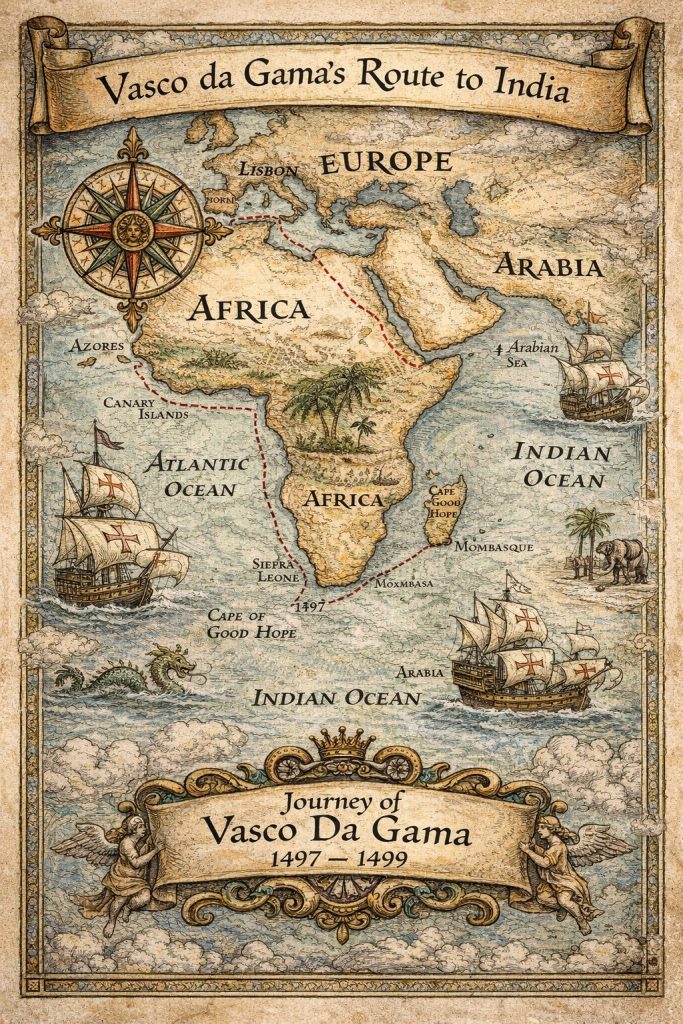
Using the knowledge gained from Dias’s expedition, da Gama sailed around the Cape of Good Hope and continued north along the east coast of Africa.
Eventually, he crossed the Indian Ocean and reached India.
This completed the goal that Portugal had been working toward for decades.
Without Dias’s earlier journey, this would not have been possible.
The Indian Ocean Trade Network
Dias’s discovery helped connect Europe to the Indian Ocean, which was already home to a rich and complex trade network.
For centuries, traders from Africa, the Middle East, India, and Southeast Asia had exchanged goods across these waters.
These goods included:
- Spices like pepper and cinnamon
- Silk and fine fabrics
- Gold and ivory
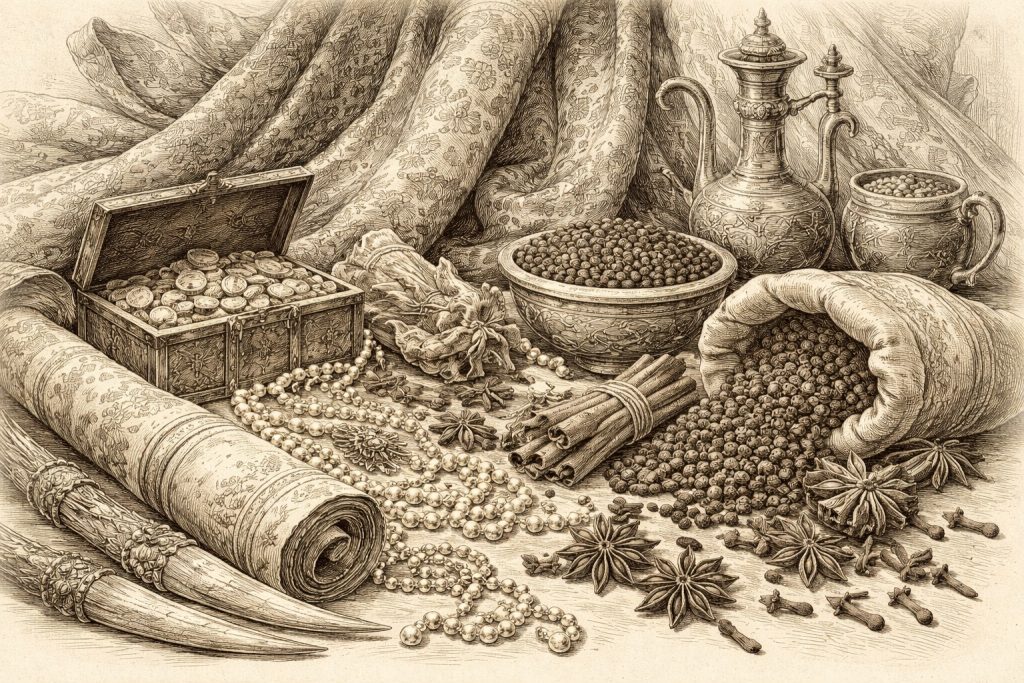
When Portuguese ships entered this network, it changed global trade forever.
The Impact on Portugal
Portugal quickly became one of the most powerful trading nations in the world.
By controlling sea routes, Portuguese merchants could:
- Trade directly with Asian markets
- Avoid expensive land routes
- Build a global trading empire
Ports along the African coast and in Asia became important centers of Portuguese activity.
Challenges and Consequences
Like earlier exploration, Dias’s voyage had both positive and negative effects.
Positive Effects:
- Expanded knowledge of geography
- Improved navigation and ship design
- Created new trade opportunities
Negative Effects:
- Led to European domination of trade routes
- Increased conflict with local populations
- Contributed to systems of exploitation and colonization
Understanding these outcomes helps us see the full picture of history.
What Made Dias Successful?
Several qualities helped Bartolomeu Dias succeed:
1. Courage
He was willing to sail into unknown and dangerous waters.
2. Skill
He understood navigation and how to manage ships in difficult conditions.
3. Determination
Even after storms and setbacks, he continued his mission.
4. Leadership
He guided his crew through fear and uncertainty, even when they disagreed.
A Turning Point in History
Dias’s voyage marked a turning point in world history.
For the first time, Europe had a clear path to reach Asia by sea.
This led to:
- Increased global trade
- Cultural exchanges between continents
- The beginning of a more connected world
It also began a new era of competition among European nations for power and wealth.
Imagining the Voyage
To truly understand Dias’s journey, imagine what it was like:
- Months at sea with limited food
- No modern maps or technology
- Constant danger from storms
- The fear of the unknown
Every decision mattered. Every mile could bring discovery—or disaster.
And yet, despite all of this, Dias and his crew succeeded.
Conclusion: The Man Who Opened the Ocean Path
Bartolomeu Dias may not be as famous as some later explorers, but his achievement was extraordinary.
By rounding the Cape of Good Hope, he showed that the Atlantic Ocean was connected to the Indian Ocean. He opened the door to a new route—one that would reshape global trade and exploration.
His voyage represents the spirit of the Age of Exploration:
- Curiosity about the unknown
- Courage in the face of danger
- Determination to push beyond limits
For middle school students studying history, Dias’s story reminds us that great discoveries often come from taking risks and asking big questions.
And sometimes, even when a journey does not reach its final destination, it can still change the world.
Bartolomeu Dias did not reach India—but he made it possible for others to do so.
And in doing that, he helped open a new chapter in human history.
