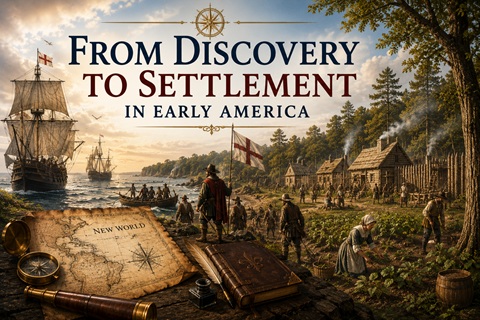
From Discovery to Settlement in Early America

A Bridge from Discovery to Settlement

When we study early American history, it is easy to jump straight into the story of colonies like Jamestown or Plymouth. But these settlements did not appear out of nowhere. They were the result of many years of exploration, trial and error, and learning from both success and failure.

To truly understand how England built colonies in North America, we must first understand the connection between exploration and colonization. Exploration opened the door. Colonization tried to walk through it.

This essay will guide you through that journey—from early voyages across the Atlantic, to the rise of joint-stock companies, and finally to the founding of Jamestown in 1607. By the end, you will see how all of these pieces fit together into the beginning of Colonial America.


What Is Exploration?

Exploration is the act of traveling to unknown or unfamiliar places in order to learn about them. During the 1400s and 1500s, European countries began exploring the world in ways they had never done before. This period is often called the Age of Exploration.

Several important factors pushed European nations to explore:

  • Trade – They wanted new routes to Asia for spices, silk, and other valuable goods
  • Wealth – Gold, silver, and other resources could make a nation rich
  • Power – Countries competed to become stronger than their rivals
  • Religion – Some hoped to spread Christianity

Spain and Portugal were the first to lead the way. Explorers like Christopher Columbus and Ferdinand Magellan made famous voyages that connected Europe to the Americas and around the globe.

England, however, was slower to begin exploring. But when it did, it quickly became determined to catch up.


England Enters the Race

In the late 1500s, England began to take exploration more seriously under the leadership of Elizabeth I.

England had several goals:

  • Challenge the power of Spain
  • Find new trade routes
  • Establish colonies for resources and trade
Key figures in England's path from discovery to settlement

Explorers such as John Cabot (who sailed in 1497) had already claimed parts of North America for England, but no permanent settlements had been established yet.

That would soon change.


From Exploration to Colonization

At first, exploration was about discovery—mapping coastlines, meeting new peoples, and claiming land. But over time, countries realized that simply discovering land was not enough.

They wanted to stay.

This is where colonization comes in.

A colony is a settlement of people who move from their home country to live in a new land, but still remain connected to their original nation.

Why did countries want colonies?

  • To gain resources like timber, furs, and crops
  • To create markets for trade
  • To establish military bases
  • To increase national power

Exploration showed that land existed. Colonization was the attempt to use that land.


Early English Attempts at Colonization

England’s first efforts at colonization were not very successful. One of the most famous early attempts was led by Sir Walter Raleigh.

Raleigh sponsored a colony on Roanoke Island in the 1580s.

As you may already know, this colony disappeared, becoming known as the Lost Colony of Roanoke.

Although Roanoke failed, it was extremely important because it taught the English several lessons:

  • Colonies needed better planning
  • Settlers needed farming skills, not just soldiers
  • Strong leadership was essential
  • Supplies and support from England were critical

Failure, in this case, became a teacher.


The Big Problem: Colonies Cost Money

One of the biggest challenges of colonization was cost.

Think about what it takes to start a colony:

  • Ships and crews
  • Food and supplies
  • Tools and equipment
  • Protection (weapons, soldiers)
  • Time (colonies did not make money right away)

All of this was very expensive. The English government did not always want to pay for it directly.

So how could England afford to build colonies?

The answer was a new idea: joint-stock companies.


What Is a Joint-Stock Company?

A joint-stock company was a business organization in which many investors pooled their money together to support a venture.

Instead of one person taking all the risk, many people shared it.

Here’s how it worked:

  1. Investors bought shares in a company
  2. The company used the money to fund an expedition or colony
  3. If the colony succeeded, investors shared the profits
  4. If it failed, they lost their investment

This was a smart way to reduce risk and raise large amounts of money.

It also marked the beginning of something very important: the connection between business and colonization.


Why Joint-Stock Companies Mattered

Joint-stock companies made colonization possible in ways that had not been before.

They allowed England to:

  • Fund large and expensive expeditions
  • Involve wealthy merchants and investors
  • Spread financial risk
  • Encourage economic growth

Colonization was no longer just a royal project—it became a business opportunity.

One of the most important joint-stock companies in English history was the Virginia Company.


The Virginia Company’s Big Idea

The Virginia Company was formed in 1606 with the goal of establishing a permanent colony in North America.

The company had two main branches:

  • The London Company
  • The Plymouth Company

The London Company was responsible for founding a colony in the southern part of Virginia.

Sir Humphrey Gilbert presenting his plan to Queen Elizabeth I

Their goal was clear:

  • Find gold and valuable resources
  • Establish trade with Native Americans
  • Create a profitable settlement

They learned from earlier failures like Roanoke and tried to prepare more carefully.


Preparing for a New Colony

Before sending settlers to America, the Virginia Company made several important preparations:

1. Choosing the Right People

This time, they did not send only soldiers. They included:

  • Gentlemen (wealthy men)
  • Laborers
  • Craftsmen

However, they still made a mistake: too many settlers were not used to hard physical work like farming.


2. Supplying the Expedition

The company provided:

  • Food supplies
  • Tools
  • Weapons
  • Seeds

Even so, they underestimated how difficult life in the New World would be.


3. Selecting a Location

The settlers chose a site along a river in present-day Virginia.

They named their settlement Jamestown, in honor of King James I.

The location had advantages:

  • Easy access for ships
  • Protection from Spanish attack

But it also had serious problems:

  • Swampy land
  • Disease (especially from mosquitoes)
  • Poor drinking water

Jamestown (1607): A New Beginning

In 1607, about 100 English settlers arrived and founded Jamestown—the first successful permanent English colony in North America.

At first, things did not go well.

The settlers faced:

  • Hunger
  • Disease
  • Conflict with Native Americans
  • Lack of strong leadership

This period became known as the Starving Time.


Leadership and Survival

One of the key figures in Jamestown’s survival was John Smith.

He introduced strict rules:

  • “He who does not work shall not eat.”

This helped bring order and discipline to the colony.

Another important factor was the help of Native Americans, especially the Powhatan people, who traded food with the settlers.

Without this help, the colony might not have survived.


A Turning Point: Tobacco

Jamestown began to succeed when settlers discovered a profitable crop: tobacco.

A man named John Rolfe developed a type of tobacco that was popular in Europe.

Tobacco became a cash crop, meaning it could be sold for profit.

This changed everything:

  • The colony began to make money
  • More settlers arrived
  • The colony became stable

At last, England had a successful foothold in North America.


How Exploration Led to Colonies

Now we can clearly see the connection between exploration and colonization.

Step 1: Exploration

Explorers mapped new lands and claimed them for their countries.

Step 2: Early Attempts

Countries tried to settle these lands, often failing at first (like Roanoke).

Step 3: Learning and Adapting

They learned from mistakes and improved their plans.

Step 4: New Systems (Joint-Stock Companies)

They created new ways to fund colonies and share risk.

Step 5: Successful Colonies

Settlements like Jamestown finally succeeded.

Exploration opened the door—but colonization required planning, money, and persistence.


Why This Matters

Understanding this process helps us see that history is not just a series of events. It is a story of people trying, failing, learning, and trying again.

The English colonies that later grew into the United States began with:

  • Risk
  • Experimentation
  • Determination

Without exploration, there would have been no colonies.

Without failure, there would have been no success.


Looking Ahead: The Growth of Colonial America

Jamestown was just the beginning.

After 1607, more colonies followed:

  • Plymouth (1620)
  • Massachusetts Bay (1630)
  • Maryland, Pennsylvania, and others

Each colony had its own reasons for being founded—some for profit, others for religious freedom.

But all of them were connected to the earlier story of exploration and colonization.


Conclusion: From Voyages to Settlements

The journey from exploration to colonization was long and difficult.

Explorers like Christopher Columbus and John Cabot helped Europeans discover new lands. Leaders like Sir Walter Raleigh attempted early settlements, even when they failed.

The creation of joint-stock companies allowed England to fund larger and more ambitious projects. Finally, the founding of Jamestown in 1607 proved that a permanent English colony could survive.

This moment marks the true beginning of Colonial America.

As we move forward, we will explore how these colonies grew, developed, and eventually became something entirely new.

The story of Colonial America begins here—with exploration, risk, and the dream of a new world.