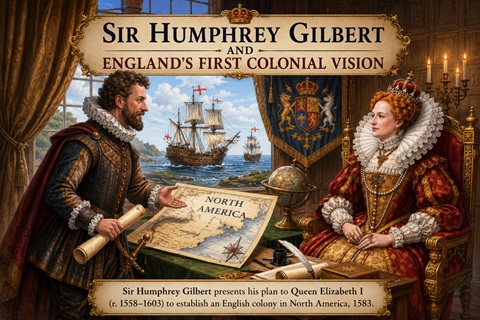
In the late 1500s, Sir Humphrey Gilbert helped shape England’s early ideas about building colonies in North America. Unlike earlier explorers who focused mainly on discovery, Gilbert believed England should establish permanent settlements. Although his own efforts were unsuccessful, his vision influenced future English colonization, including later attempts in the New World.
What You Will Learn
- Who Sir Humphrey Gilbert was and what he believed
- Why England wanted to create colonies
- How Gilbert’s ideas influenced future exploration
Who Was Sir Humphrey Gilbert?
Sir Humphrey Gilbert was an English soldier, explorer, and thinker who lived during the reign of Queen Elizabeth I. He was deeply interested in expanding England’s power and influence through exploration and settlement.
Gilbert believed that England should not only explore new lands but also establish colonies where people could live permanently. He argued that colonies could provide resources, create new trade opportunities, and strengthen England’s position against rival nations like Spain.
The Plan for Colonization
Gilbert received permission from Queen Elizabeth I to establish colonies in North America. His plan was to claim land for England, build settlements, and create a base for trade and expansion. This was a new idea at the time, as many earlier voyages focused mainly on exploration rather than settlement.
In 1583, Gilbert led an expedition to North America and claimed the land of Newfoundland for England. Although he did not establish a lasting colony, this was one of the first official English claims in the New World. His efforts marked an important step toward future colonization.
Challenges and Legacy
Gilbert faced many challenges during his expedition, including harsh weather, limited supplies, and difficulty organizing settlers. On his return journey to England, his ship was lost at sea, and he did not survive.
Despite his failure, Gilbert’s ideas had a lasting impact. His vision of permanent colonies influenced later explorers and leaders, including his half-brother Sir Walter Raleigh, who attempted to establish the Roanoke Colony. Gilbert’s efforts helped lay the groundwork for England’s future success in colonizing North America.
Conclusion
Sir Humphrey Gilbert played an important role in shaping England’s early colonial ambitions. Although his own expedition did not succeed, his vision of permanent settlement influenced future efforts and helped England begin its journey toward building an empire in the Americas. His story shows how ideas can have a lasting impact, even when initial attempts fail.
Key Terms
- Colony: A settlement established by people from one country in a new land.
- Charter: An official document granting rights or permission, often from a monarch.
Review Questions
- What made Sir Humphrey Gilbert’s ideas different from earlier explorers?
- What did Gilbert accomplish during his expedition to North America?
- How did Gilbert influence future English colonization?
Think Further
Extension Activity: Design a Colonial Plan
Objective:
To help students understand the planning and difficulties involved in early colonization efforts.
Instructions:
Students will create their own plan for establishing a colony.
- Choose a location in North America for your colony.
- Decide what resources you will need (food, tools, people).
- Describe the purpose of your colony (trade, farming, defense, etc.).
- Write a short paragraph explaining the challenges you might face and how you would overcome them.
From Indigenous North America to European Colonization
Indigenous North America Before 1500
The European Age of Exploration
From Revolution to the Eve of Civil War
The Early Republic
The Jacksonian Era
Westward Expansion
The Late 19th Century
The American Civil War
Reconstruction
The Gilded Age
The Early 20th Century
The Progressive Era
World War I
The Roaring 20s and the Great Depression
Modern America Emerges
World War II
The Cold War
Post Cold War America
Modern America