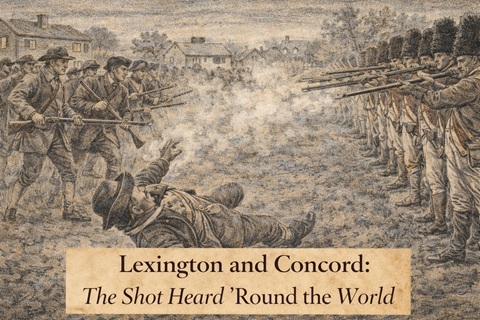
It was still dark on the morning of April 19, 1775. A cool spring breeze moved quietly through the trees, and most people in the Massachusetts countryside were still asleep. But something important—something that would change history—was already in motion.
British soldiers were marching through the night.
They had a mission: to reach the towns of Lexington and Concord, find weapons stored by colonial militia, and seize them before the colonists could use them.
But the colonists were ready.
And before the sun rose fully into the sky, the first shots of the American Revolution would be fired.
1. A Night of Warnings
The story of Lexington and Concord really begins the night before.
British General Thomas Gage, who was in charge of British forces in Boston, had received orders. He was told to:
- Take control of colonial weapons
- Stop the growing resistance
- Arrest important colonial leaders if possible
He planned a secret mission.
The British plan
On the evening of April 18, 1775:
- About 700 British soldiers (called “Redcoats”) quietly left Boston
- They crossed the Charles River
- They began marching toward Concord
The British hoped to surprise the colonists.
But the colonists found out
Colonial leaders had spies and watchers in place.
As soon as the British began their march, word spread quickly.
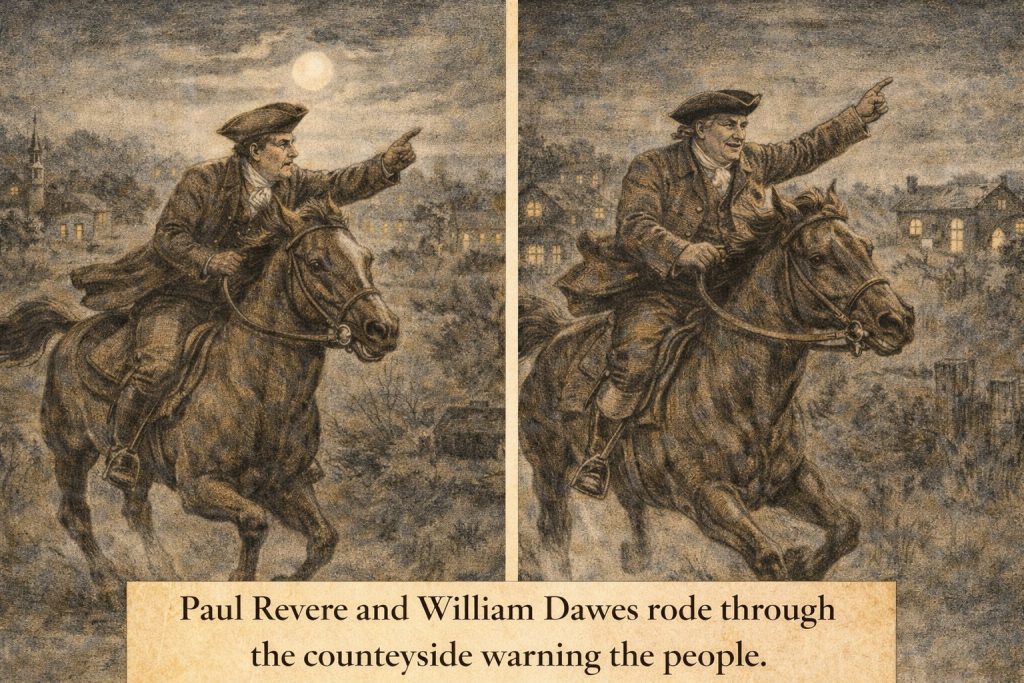
Two riders became especially important:
- Paul Revere
- William Dawes
They rode through the countryside, warning people:
“The British are coming!”
(Actually, they probably said something like “The Regulars are coming,” since most colonists still considered themselves British.)
The alarm spreads
As the riders moved from town to town:
- Church bells rang
- Signals were sent
- Militia members began to gather
By the time the British reached Lexington, they were no longer a surprise.
2. The Minutemen Prepare
In the town of Lexington, a small group of colonial militia gathered on the town green.
These men were known as Minutemen.
Why were they called Minutemen?
Because they were ready to fight at a minute’s notice.
They were not professional soldiers, but they were:
- Farmers
- Shopkeepers
- Ordinary citizens
And they were prepared to defend their homes.
A quiet, tense morning
As dawn approached:
- About 70 Minutemen stood on the green
- They were led by Captain John Parker
Parker reportedly told his men:
“Stand your ground. Don’t fire unless fired upon. But if they mean to have a war, let it begin here.”
The mood was tense. No one knew what would happen next.
3. The Battle of Lexington
As the sun began to rise, the British soldiers arrived.
What did they see?
- A small group of armed colonists
- Standing on the green
- Watching and waiting
The British commander ordered the colonists to disperse.
The moment of confusion
What happened next is still debated.
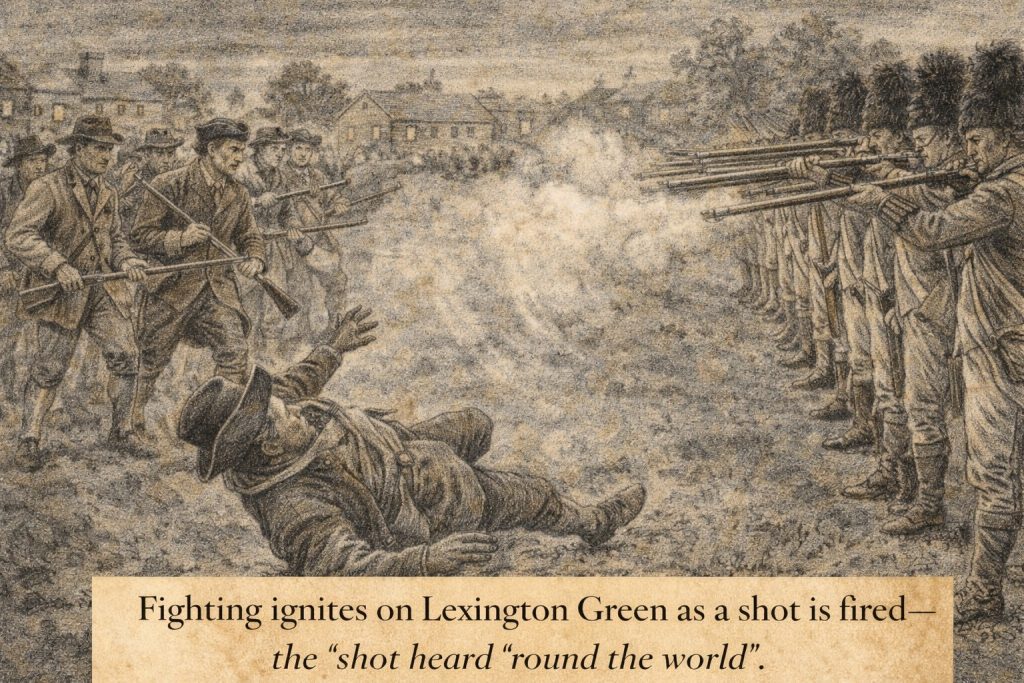
- Someone fired a shot
- No one knows exactly who fired first
This first shot became known as:
“The shot heard ’round the world.”
Why is it called that?
Because it marked the beginning of a conflict that would:
- Lead to the American Revolution
- Influence ideas about freedom around the world
The result at Lexington
After the first shot:
- British soldiers fired a volley
- Eight colonists were killed
- Several others were wounded
The Minutemen were forced to retreat.
A quick but important clash
The Battle of Lexington lasted only a few minutes.
But it was incredibly important.
For the first time:
- Colonists and British soldiers had fought and killed each other
There was no turning back.
4. The British March to Concord
After Lexington, the British continued their march to Concord.
Their goal was still the same:
- Find and destroy colonial weapons
What did they find?
When the British arrived:
- Many weapons had already been hidden
- Supplies had been moved
The colonists had prepared well.
Dividing their forces
The British split into groups to search the area.
Meanwhile, colonial militia were gathering nearby.

5. The North Bridge at Concord
The next major moment came at the North Bridge in Concord.
What was happening?
- British soldiers were guarding the bridge
- Colonial militia were gathering on the other side
The number of colonists was growing.
They were becoming more confident.
The colonists advance
Eventually, the colonial militia decided to move forward.
They:
- Marched toward the bridge
- Formed organized lines
This was no longer just a small group—it was a larger force.
The fighting begins
At the bridge:
- Shots were fired
- The colonists returned fire
This time, the colonists were more organized.
The result
- The British were forced to retreat
- The colonists had successfully pushed them back
This was a turning point.
At Lexington, the colonists had retreated.
At Concord, they stood their ground—and won.
6. The British Retreat Begins
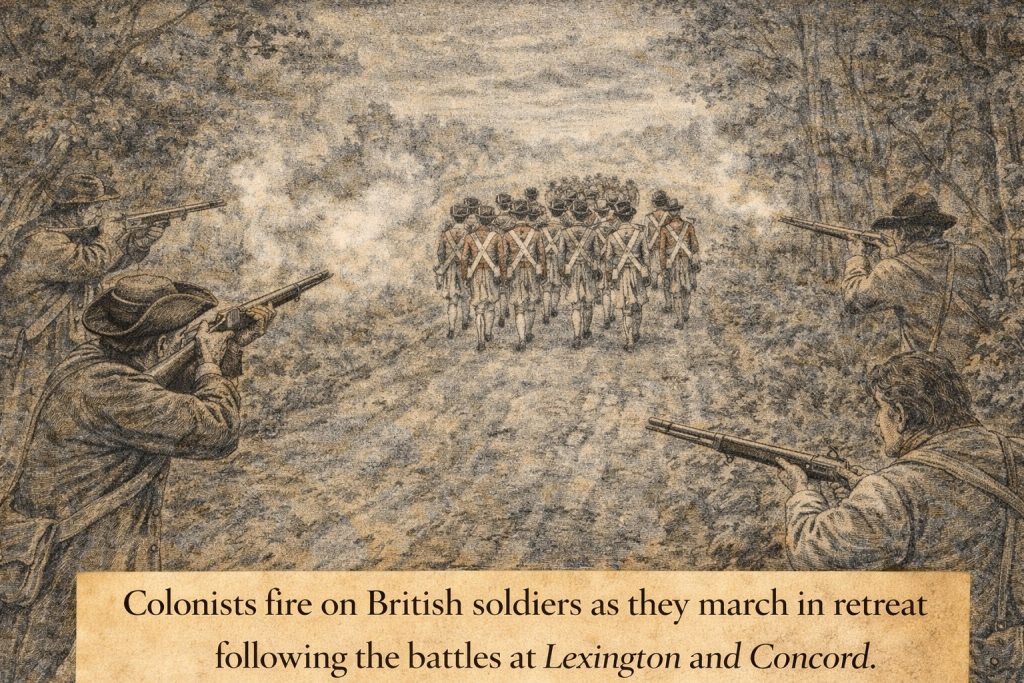
After the fighting at Concord, the British began their march back to Boston.
But this retreat would be very different from their march out.
The countryside rises
As the British moved:
- More and more colonial militia joined the fight
- Farmers and townspeople gathered along the road
The colonists used a new strategy.
Fighting from behind cover
Instead of lining up in open fields, the colonists:
- Hid behind trees
- Took cover behind stone walls
- Fired from a distance
This made it very difficult for the British.
7. A Long and Dangerous March
The British retreat turned into a long and exhausting battle.
What happened?
- Colonists attacked from all sides
- British soldiers were constantly under fire
- The march became chaotic
Reinforcements arrive
At one point, British reinforcements arrived to help.
This prevented a complete disaster for the British.
By the time they reached Boston:
- The British had suffered heavy losses
- The colonists had shown they could fight effectively
8. The Results of Lexington and Concord
The events of April 19, 1775, had a huge impact.
Casualties
- About 250 British soldiers were killed or wounded
- About 90 colonists were killed or wounded
More important than numbers
What really mattered was what the fighting meant.
9. Why These Battles Were So Important
Lexington and Concord were important for several reasons.
A. The war had begun
Before this day:
- There had been protests
- There had been tension
After this day:
- There was open fighting
The American Revolution had started.
B. The colonists showed strength
The colonists proved they could:
- Organize
- Fight
- Stand up to British troops
C. Unity increased
Colonists from different towns:
- Worked together
- Fought together
This strengthened their sense of unity.
10. The Meaning of “The Shot Heard ’Round the World”
The phrase comes from a poem by Ralph Waldo Emerson.
Why is it so important?
Because that single shot:
- Started a war
- Led to the creation of a new nation
- Inspired ideas about freedom and independence
11. A New Reality
After Lexington and Concord, everything changed.
Colonists realized:
- Conflict with Britain could not be avoided
- They needed to prepare for a larger war
Britain realized:
- The colonies were willing to fight
- Controlling them would not be easy
12. The Road Ahead
After these battles:
- Colonial forces surrounded Boston
- The conflict grew into a full war
Within a year:
- The colonies would declare independence
13. Could It Have Been Avoided?
It’s worth asking:
Could Lexington and Concord have been prevented?
Possibly—if:
- Communication had been better
- Compromise had been reached
- Trust had not broken down
But by 1775, tensions were already too high.
14. A Story of Ordinary People
One of the most powerful things about Lexington and Concord is who was involved.
The colonists were not professional soldiers
They were:
- Farmers
- Craftsmen
- Neighbors
They stood up because they believed in their rights.
15. A Final Thought
The events at Lexington and Concord remind us that history is often shaped by ordinary people in extraordinary moments.
On that early morning in April 1775:
- A small group of colonists stood their ground
- A single shot was fired
- And the world changed
16. Conclusion
Lexington and Concord were not large battles by today’s standards, but they were incredibly important.
They:
- Marked the beginning of the American Revolution
- Showed that the colonies were ready to fight
- Set the stage for independence
The “shot heard ’round the world” was more than just a sound—it was the start of a movement that would change history forever.
Reflection Questions
- Why were the British marching to Lexington and Concord?
- Why do you think no one knows who fired the first shot?
- How did the colonists’ strategy during the British retreat help them succeed?
- Why do you think history presents these events as the start of the American Revolution?