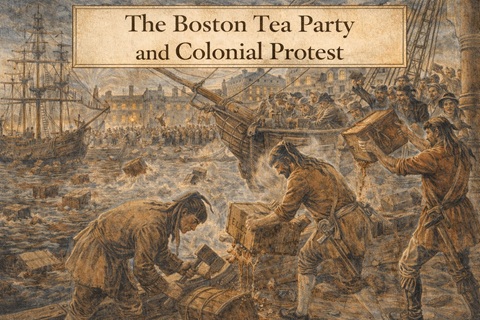
Imagine you are living in Boston in 1773. Ships sit quietly in the harbor, their cargo holds filled with tea. But this is not just any tea—it represents a problem, a protest, and a growing conflict between the American colonies and Great Britain.
Within days, that tea would be dumped into the cold waters of Boston Harbor in one of the most famous acts of protest in history.
This event, known as the Boston Tea Party, was not just about tea. It was about power, rights, fairness, and resistance. It showed how far colonists were willing to go to stand up against what they believed was unjust treatment.
Let’s explore what led to this dramatic moment and why it mattered so much.
1. The Problem Begins: Taxes and Control
To understand the Boston Tea Party, we need to look at what had been happening in the years leading up to it.
After the French and Indian War, Britain faced a major problem:
- It had huge debt
- It needed money to manage and protect its empire
Britain’s solution:
Parliament passed a series of taxes on the American colonies, including:
- The Stamp Act
- The Townshend Acts
These taxes made colonists angry because:
- They had no representation in Parliament
- They felt the taxes were unfair
This led to the powerful idea:
“No taxation without representation.”
2. The Tea Act of 1773: A New Kind of Problem
By 1773, tensions had already been building for years. Then Britain passed a new law called the Tea Act.
What did the Tea Act do?
- It gave the British East India Company the exclusive right to sell tea in the colonies
- It allowed the company to sell tea more cheaply than before
- It still included a tax on tea
3. Why Were Colonists Upset About Cheaper Tea?
At first, this might seem confusing.
If tea was cheaper, why would colonists be angry?
There were two main reasons:
1. The tax was still there
Even though the tea was cheaper, colonists believed:
- Buying it meant accepting Parliament’s right to tax them
2. It hurt local businesses
Colonial merchants:
- Could not compete with the British East India Company
- Felt pushed out of the market
So the Tea Act was not just about tea—it was about control and fairness.
4. Colonial Protest Begins Again
As news of the Tea Act spread, colonists began to protest.
What did they do?
- Refused to buy British tea
- Organized meetings and rallies
- Warned ship captains not to unload tea
In many cities, colonists successfully prevented tea from being delivered.
But Boston would be different.
5. Why Boston Became the Center of Conflict
Boston had already been a place of strong resistance.
Why?
- It had experienced earlier tensions like the Boston Massacre
- It had active protest groups like the Sons of Liberty
- It had strong leaders who opposed British policies
When tea ships arrived in Boston Harbor, colonists were determined to act.
6. The Tea Ships Arrive
In late 1773, three ships arrived in Boston Harbor carrying tea:
- The Dartmouth
- The Eleanor
- The Beaver
What was supposed to happen?
- The tea would be unloaded
- Taxes would be collected
What actually happened?
Colonists refused to let this happen.
7. A Standoff in Boston
For several weeks, the situation remained tense.
Colonists demanded:
- The tea be sent back to England
British officials insisted:
- The tea must be unloaded
- The law must be followed
Neither side was willing to back down.
8. December 16, 1773: The Boston Tea Party
On the night of December 16, everything came to a head.
What happened?
- A large group of colonists gathered at a meeting
- When it became clear that the tea would not be sent back, a plan was put into action
The protest begins
That evening:
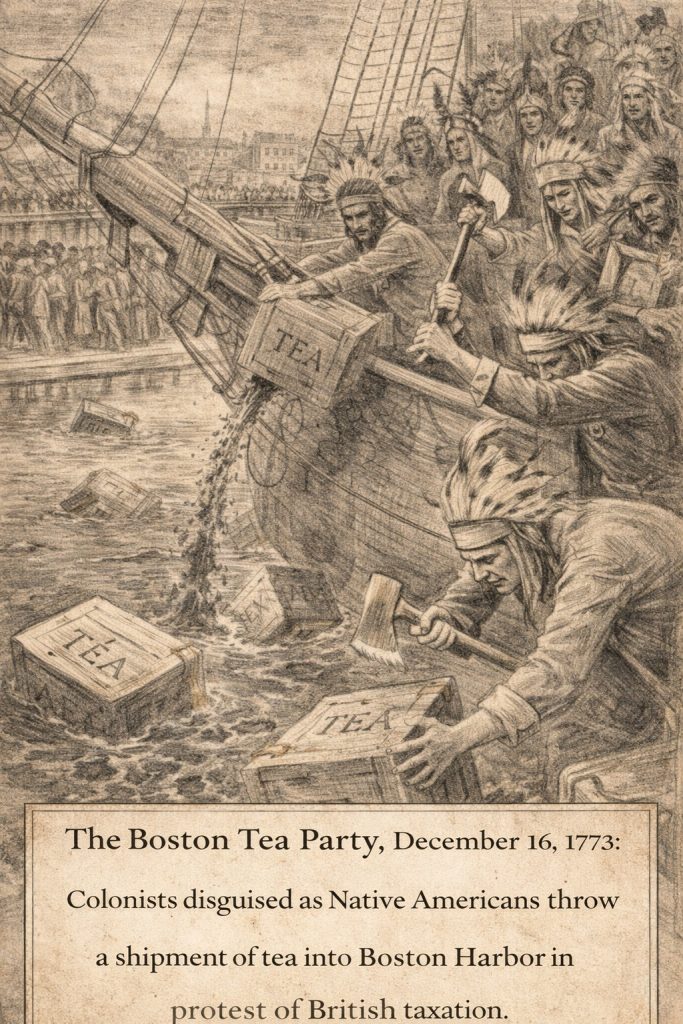
- A group of men disguised themselves—many dressed as Mohawk Indians
- They marched to the harbor
- They boarded the tea ships
The destruction of the tea
Once on board, the protesters:
- Opened the chests of tea
- Dumped them into the harbor
In total:
- 342 chests of tea were destroyed
Important details
- The protest was organized and controlled
- No one was injured
- No other property was damaged
This was not a riot—it was a planned act of protest
9. Why Disguise Themselves?
The protesters’ disguises served several purposes:
1. To hide their identities
They wanted to avoid punishment
2. To send a message
Dressing as Native Americans symbolized:
- A break from British identity
- A new, American identity
10. How Colonists Viewed the Event
Many colonists saw the Boston Tea Party as:
- A bold stand for freedom
- A necessary action against unfair laws
- A symbol of resistance
It showed that colonists were willing to take serious action to defend their rights.
11. How Britain Reacted
The British government was furious.
From their point of view:
- Valuable property had been destroyed
- Authority had been challenged
- Order had broken down
The Intolerable Acts (1774)
In response, Britain passed a series of harsh laws known as the Intolerable Acts.
These laws included:
- Closing Boston Harbor until the perpetrators paid for the tea
- Reducing self-government in Massachusetts
- Allowing British officials to be tried elsewhere
12. Why Britain’s Response Backfired
Instead of weakening the colonies, Britain’s actions had the opposite effect.
What happened?
- Other colonies supported Boston
- Colonists became more united
- Anger toward Britain grew stronger
The Boston Tea Party helped bring the colonies together.
13. The Growth of Colonial Unity
Before these events, the colonies often acted separately.
After the Tea Party and the Intolerable Acts:
- Colonies began to cooperate more closely
- Leaders communicated and shared ideas
- A sense of shared identity developed
14. The First Continental Congress
In 1774, representatives from many colonies met in Philadelphia.
Colonial leaders referred to this meeting as the First Continental Congress.
What did they do?
- Discussed how to respond to British actions
- Organized boycotts
- Sent a message to the king
This was a major step toward unity—and eventually independence.
15. Protest vs. Rebellion
The Boston Tea Party raises an important question:
Was it a protest—or was it rebellion?
As a protest, it was:
- a response to unfair laws
- organized and purposeful
As rebellion:
- It involved destroying property
- It challenged British authority directly
The answer depends on perspective.
16. Different Points of View
From the colonists’ point of view:
- They were defending their rights
- They had tried peaceful methods first
- They believed stronger action was necessary
From Britain’s point of view:
- The colonists were breaking the law
- Order needed to be restored
- Authority needed to be maintained
17. Why the Boston Tea Party Matters
The Boston Tea Party is important because it:
1. Showed colonial determination
Colonists were willing to take bold action
2. Increased tension
It pushed Britain and the colonies further apart
3. Led to harsh British responses
Which united the colonies even more
18. A Turning Point on the Road to Revolution
The Boston Tea Party did not start the American Revolution—but it moved events much closer to it.
Within just a few years:
- Fighting would break out at Lexington and Concord (1775)
- The colonies would declare independence (1776)
19. A Final Thought
The Boston Tea Party reminds us that:
- Protests can take many forms
- People will stand up when they feel treated unfairly
- Actions can have unexpected consequences
What began as a protest over tea became a powerful symbol of resistance—and a major step toward the creation of a new nation.
Reflection Questions
- Why did colonists object to the Tea Act even though tea became cheaper?
- Do you think the Boston Tea Party was justified? Why or why not?
- How did Britain’s response to the Tea Party affect the colonies?
- What role did unity play in the colonies’ growing resistance?