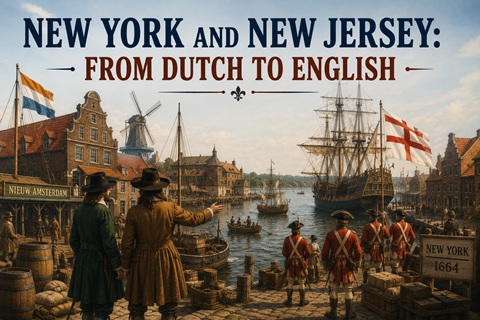
English Takeover of New Netherland, Cultural Diversity, and Trade Advantages
When we think about the early American colonies, we often picture English settlers building towns along the Atlantic coast. But not all of these colonies began as English. In fact, one of the most important regions in early American history—what we now know as New York and New Jersey—was first settled by the Dutch.
This region, called New Netherland, became one of the most diverse and economically important areas in North America. It changed hands from the Dutch to the English, but many of its unique features remained. Its diversity, location, and focus on trade helped shape its future and made it different from other colonies like Massachusetts or Virginia.
Let’s explore how New Netherland became New York and New Jersey, why so many different people lived there, and how its location helped it grow into a powerful center of trade.
The Dutch Arrive in North America
Why the Dutch Came
In the early 1600s, European nations were racing to explore and claim land in the New World. Spain, France, and England were already building colonies. The Dutch, who were strong traders and sailors, wanted a share of the opportunity.
Their main goal was not to build large farming communities or religious societies. Instead, they wanted to make money through trade—especially the fur trade.
Henry Hudson’s Voyage
In 1609, an English explorer named Henry Hudson sailed for the Dutch East India Company. He was looking for a route to Asia, but instead he explored a river that would later be named after him: the Hudson River.

Hudson reported that the area was rich in natural resources, especially fur-bearing animals like beavers. This caught the attention of Dutch merchants.
Founding New Netherland
Soon after, the Dutch began establishing trading posts along the Hudson River. Over time, these settlements grew into a colony called New Netherland.
The most important settlement was New Amsterdam, located at the southern tip of Manhattan Island. This city would later become New York City.
Life in New Netherland
A Trading Colony
Unlike some English colonies, New Netherland was not focused on religion or farming alone. It was a business venture.
The Dutch West India Company controlled the colony. Its main goal was profit. Settlers were encouraged to trade with Native Americans, especially for furs.
This made New Netherland a busy and active place.
The Fur Trade
The fur trade was central to the colony’s economy. European demand for beaver hats was very high, and Native Americans were skilled hunters.
The Dutch traded goods such as:
- Metal tools
- Cloth
- Weapons
- Alcohol
In return, they received animal furs, which they shipped back to Europe.
The Patroon System
To encourage settlement, the Dutch created a system called the patroon system.
Wealthy investors, called patroons, were given large tracts of land along the Hudson River. In return, they agreed to bring settlers to live and work on the land.
This system created large estates, almost like mini kingdoms, where patroons had significant power.
A Diverse Population
One of the most interesting things about New Netherland was its diversity.
People from Many Places
Because the Dutch were focused on trade rather than strict religious rules, they allowed people from many different backgrounds to settle in the colony.
By the mid-1600s, New Amsterdam was home to people from:
- The Netherlands
- Germany
- France
- Scandinavia
- Africa
- England
- Jewish communities from Europe
In fact, more than a dozen different languages were spoken in the colony.
Religious Tolerance
The Dutch were generally more tolerant than many other European groups at the time. While the Dutch Reformed Church was the official religion, people were often allowed to practice their own beliefs.
This made New Netherland attractive to people who were not welcome in stricter colonies like Massachusetts.
Enslaved Africans
It is also important to understand that enslaved Africans were part of New Netherland’s population. The Dutch West India Company brought enslaved people to work in the colony.
Some enslaved Africans were able to earn limited freedoms, but they still faced harsh conditions and restrictions.
This reminds us that while the colony was diverse, it was not equal for everyone.
New Amsterdam: A Busy Port City
A Strategic Location
New Amsterdam was located in one of the best natural harbors in North America. Ships could easily enter and leave, making it an ideal place for trade.
The Hudson River allowed goods to be transported far inland. This connected the colony to Native American trading networks and other settlements.
A Growing City
By the 1660s, New Amsterdam had become a lively town with:
- Markets
- Warehouses
- Taverns
- Homes and farms
People bought and sold goods, exchanged news, and interacted with others from different cultures.
It was very different from the more orderly and religious-focused towns of New England.
Problems in New Netherland
Despite its success in trade, New Netherland had some weaknesses.
Weak Leadership
Some of the colony’s governors were not very effective. One of the most famous was Peter Stuyvesant.
Stuyvesant was strict and tried to enforce order, but many colonists did not like his leadership. They wanted more say in how the colony was run.
Limited Population
Compared to English colonies, New Netherland had a smaller population. This made it harder to defend the colony against threats.
Competition with England
The English had colonies to the north (New England) and the south (Virginia). They wanted control of the land in between.
New Netherland stood in their way.
The English Takeover
Why England Wanted New Netherland
England saw New Netherland as valuable for several reasons:
- It connected their northern and southern colonies
- It had a strong trading economy
- It occupied a strategic location along the coast
In 1664, the English decided to take control.
A Bloodless Conquest
The English sent a fleet of ships to New Amsterdam. They demanded that the Dutch surrender.
Governor Peter Stuyvesant wanted to fight, but many colonists refused to support him. They did not want war, and some believed the English might offer better opportunities.
Without much resistance, the Dutch surrendered.
A New Name
The English renamed the colony New York, after the Duke of York, who had been given control of the land by the king.
New Amsterdam became New York City.
The Creation of New Jersey
Dividing the Land
After taking control, the English divided part of the territory into a separate colony: New Jersey.
This land was given to two proprietors (owners), who encouraged people to settle there.
Settlement in New Jersey
New Jersey attracted settlers from different backgrounds, including:
- English farmers
- Dutch families
- Swedish settlers
Like New York, New Jersey became a diverse colony.
Over time, it developed into a place with farms, small towns, and growing trade.
What Changed—and What Stayed the Same
Changes Under English Rule
After the English took over, some things changed:
- English became the main language
- English laws and systems of government were introduced
- The colony became part of the English Empire
What Stayed the Same
However, many important features remained:
- Cultural diversity continued
- Trade remained central to the economy
- Dutch influence could still be seen in architecture, language, and customs
Even today, place names like Harlem (from Haarlem) and Brooklyn (from Breukelen) reflect the Dutch past.
Cultural Diversity in New York and New Jersey
A Unique Colonial Society
Unlike some colonies that were mostly made up of one group, New York and New Jersey were truly multicultural.
People from different countries, religions, and backgrounds lived side by side.
Why Diversity Was Important
This diversity had several benefits:
- Exchange of ideas
People brought different skills, traditions, and knowledge. - Economic growth
A mix of cultures helped support trade and business. - Tolerance (to some extent)
While not perfect, these colonies were generally more accepting than others.
Challenges of Diversity
Of course, diversity also brought challenges:
- Language barriers
- Cultural misunderstandings
- Conflicts between groups
But overall, the mix of people helped shape the identity of the region.
Trade and Economic Strength
Natural Advantages
New York and New Jersey had several natural advantages:
- Deep harbors for ships
- Rivers for transportation
- Fertile land for farming
These features made it easier to move goods and grow crops.
Trade Networks
The colonies became part of a larger trade network that included:
- Other English colonies
- The Caribbean
- Europe
- Africa
Goods such as furs, grain, timber, and manufactured items were traded across long distances.
A Growing Economy
Because of trade, cities like New York grew quickly. Merchants, shipbuilders, and traders all found opportunities.
This made the region one of the most economically important in North America.
Why Location Mattered
The Middle Colonies
New York and New Jersey were part of what became known as the Middle Colonies.
They were located between:
- New England (to the north)
- The Southern Colonies (to the south)
This central location helped them connect different regions.
A Gateway to the Interior
The Hudson River and other waterways allowed access to the interior of the continent.
This made it easier to trade with Native Americans and transport goods inland.
A Transportation Hub
Over time, the region became a major transportation center, linking land and sea routes.
This advantage continues today, as New York City remains one of the most important cities in the world.
The Lasting Impact
The story of New Netherland becoming New York and New Jersey is more than just a change in ownership. It shows how ideas, people, and geography can shape history.
Key Contributions
This region contributed to American history by promoting:
- Cultural diversity
- Economic opportunity
- Trade and commerce
- A mix of traditions and ideas
A Different Kind of Colony
Unlike colonies founded mainly for religion or farming, New York and New Jersey grew because of trade and diversity.
This made them more flexible and open to change.
Conclusion
The journey from New Netherland to New York and New Jersey is a fascinating story of change and continuity.
The Dutch built a colony focused on trade and openness. When the English took over, they brought new systems and control—but they did not erase what had already been created.
Instead, the region kept its diversity, its economic strength, and its importance as a center of trade.
For middle school students studying American history, this story is a reminder that the United States was shaped by many different people and ideas—not just one group or one culture.
And it all began, in part, with a small Dutch colony along the Hudson River that grew into something much bigger.