Overview
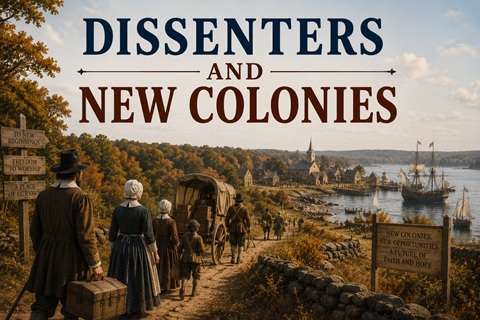
Not everyone in the Massachusetts Bay Colony agreed with Puritan leaders or accepted the colony’s strict religious rules. Some individuals believed that people should have greater religious freedom and that government leaders should not control religious beliefs. These dissenters challenged Puritan authority and were often forced to leave the colony. As they settled elsewhere, they founded new colonies that helped expand English settlement in North America and introduced new ideas about religious freedom and self-government. This lesson follows the lesson plan outline provided in the uploaded document.
What You Will Learn
- Explain why some colonists disagreed with Puritan leaders in Massachusetts Bay.
- Describe how Roger Williams and Anne Hutchinson challenged colonial authority.
- Understand how dissenters helped create new colonies and expand religious freedom.
Disagreements in Massachusetts Bay
The Puritans came to North America hoping to create a society based on their religious beliefs. However, maintaining religious unity proved difficult. As the colony grew, some settlers began questioning the authority of church leaders and the strict rules that governed daily life. These disagreements created tension within the colony.
Puritan leaders believed that unity was necessary for the success of their community. They expected colonists to follow accepted religious teachings and often punished those who openly disagreed. People who challenged church or government leaders risked fines, imprisonment, or banishment. As a result, some dissenters chose—or were forced—to leave Massachusetts Bay and establish new settlements elsewhere.
Roger Williams and Anne Hutchinson
One of the most famous dissenters was Roger Williams. Williams argued that government officials should not interfere in religious matters and that individuals should be free to worship according to their own beliefs. He also believed that colonists should fairly purchase land from Indigenous peoples rather than simply claiming it. Because of these views, Massachusetts Bay leaders banished him from the colony in 1635.
Another important dissenter was Anne Hutchinson. She held meetings in her home where she discussed religious ideas and criticized some colony ministers. Hutchinson argued that faith and God’s grace were more important than strict obedience to religious rules. Her growing influence worried colonial leaders, who viewed her teachings as a threat to authority. She was put on trial and eventually banished from Massachusetts Bay. Both Williams and Hutchinson became important symbols of religious freedom and independent thinking.
The Founding of New Colonies
After leaving Massachusetts Bay, Roger Williams founded the colony of Rhode Island. Rhode Island became known for allowing religious freedom and welcoming people with different beliefs. Unlike many other colonies of the time, it did not require settlers to follow a single religion. This made Rhode Island a refuge for individuals seeking greater liberty.
Other dissenters also helped establish new settlements throughout New England and beyond. These colonies attracted people who wanted more freedom in religious and political matters. Over time, the growth of new colonies contributed to greater diversity in Colonial America. The ideas promoted by dissenters, especially religious tolerance and individual rights, would later influence the development of American government and society.
Conclusion
Dissenters played an important role in the history of Colonial America by challenging established authority and seeking greater freedom. Leaders such as Roger Williams and Anne Hutchinson questioned the strict rules of Massachusetts Bay and helped inspire the creation of new colonies. Their actions expanded opportunities for religious freedom and introduced ideas that would have a lasting impact on American history.
Key Terms
- Dissenter – A person who disagrees with established beliefs, policies, or authorities.
- Religious Tolerance – The acceptance of people who hold different religious beliefs.
Review Questions
- Why did some colonists disagree with the leaders of Massachusetts Bay?
- How did Roger Williams and Anne Hutchinson challenge Puritan authority?
- What impact did dissenters have on the creation of new colonies in North America?
Extension Activity
Put a Colonial Dissenter on Trial
Objective
Examine the arguments surrounding religious freedom and authority by creating a mock trial based on the experiences of Roger Williams or Anne Hutchinson.
Instructions
- Choose either Roger Williams or Anne Hutchinson as the focus of your project.
- Research the beliefs and actions that led to their banishment from Massachusetts Bay.
- Divide the trial into two sides: colonial leaders and the dissenter.
- Prepare opening statements, evidence, and arguments for each side.
- Conduct the mock trial in class or present it as a written dialogue.
- Conclude with a written verdict explaining whether you believe the colony’s decision was justified and support your opinion with historical evidence.
From Indigenous North America to European Colonization
Indigenous North America Before 1500
The European Age of Exploration
From Revolution to the Eve of Civil War
The Early Republic
The Jacksonian Era
Westward Expansion
The Late 19th Century
The American Civil War
Reconstruction
The Gilded Age
The Early 20th Century
The Progressive Era
World War I
The Roaring 20s and the Great Depression
Modern America Emerges
World War II
The Cold War
Post Cold War America
Modern America