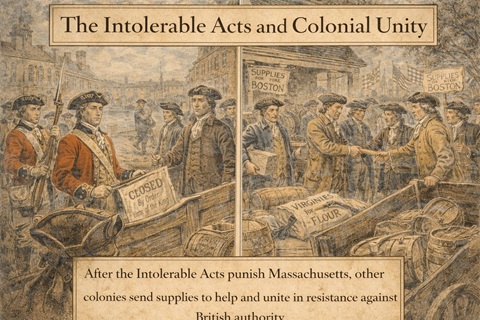
Imagine that your entire town is being punished for something a group of people did—your harbor is closed, your government is limited, and soldiers are given more power over your daily life. You didn’t personally dump tea into the harbor, but you are still affected by the consequences.
This is exactly what happened to the people of Boston in 1774.
After the Boston Tea Party, the British government responded with a series of harsh laws known as the Intolerable Acts. These laws were meant to punish Massachusetts and restore British authority—but instead, they had the opposite effect. Rather than dividing the colonies, they brought them together.
In this essay, we will explore what the Intolerable Acts were, why Britain passed them, how colonists reacted, and why these events became a major step toward the American Revolution.
1. The Road to the Intolerable Acts
To understand the Intolerable Acts, we need to look at what led up to them.
Growing tensions
For years, colonists had been growing increasingly frustrated with British rule. They objected to:
- Taxes like the Stamp Act and Townshend Acts
- The idea of taxation without representation
- Increased British control over colonial life
The Boston Tea Party (1773)
The breaking point came in December 1773, when colonists in Boston:
- Boarded British ships
- Dumped 342 chests of tea into Boston Harbor
This protest was a direct challenge to British authority.
2. Britain’s Response: Punishment and Control
The British government was shocked and angered by the Boston Tea Party.
From their point of view:
- Property had been destroyed
- Laws had been openly defied
- Authority had been challenged
They believed strong action was necessary.
What were the Intolerable Acts?
In 1774, Parliament passed a series of laws that colonists called the Intolerable Acts (the British called them the Coercive Acts).
These laws were designed to:
- Punish Massachusetts
- Restore order
- Warn other colonies not to resist
3. The Boston Port Act: Closing the Harbor
The first and most immediate law was the Boston Port Act.
What did it do?
- Closed Boston Harbor
- Stopped all trade in and out of the city
- Remained in effect until the destroyed tea was paid for
Why was this important?
Boston depended on its harbor for:
- Trade
- Jobs
- Supplies
Closing the harbor meant:
- Businesses suffered
- Workers lost income
- The entire city struggled
4. The Massachusetts Government Act: Limiting Self-Government
The next law targeted Massachusetts’ government.
What did it do?
- Reduced the power of local government
- Allowed the British governor to appoint officials
- Limited town meetings
Why did this upset colonists?
Colonists believed they had the right to:
- Govern themselves
- Make decisions through elected representatives
This law took away those rights.
5. The Administration of Justice Act
This law was especially controversial.
What did it do?
- Allowed British officials accused of crimes to be tried in Britain or another colony
Why did colonists object?
They feared:
- Officials could escape punishment
- Justice would not be fair
Some colonists called it the “Murder Act” because they believed British officials could harm colonists without consequences.
6. The Quartering Act (Expanded)
The Quartering Act required colonists to house British soldiers.
What did this version do?
- Expanded the places where soldiers could be housed
- Allowed soldiers to stay in private buildings if needed
Why did this matter?
Colonists felt:
- Their homes and property were being controlled
- Their privacy was being invaded
7. Not Part of the Same Group—but Still Important: The Quebec Act
Around the same time, Britain passed the Quebec Act.
Although not officially part of the Intolerable Acts, colonists saw it as related.
What did it do?
- Expanded the boundaries of Quebec
- Allowed religious freedom for Catholics
- Limited westward expansion for colonists
Why were colonists concerned?
They worried that:
- Their land opportunities were shrinking
- British control was growing stronger
8. How Colonists Reacted
The Intolerable Acts had a powerful impact on the colonies.
In Boston:
- The city struggled economically
- People faced hardship and uncertainty
In other colonies:
- Colonists were shocked by Britain’s actions
- Many felt sympathy for Boston
9. A Surprising Result: Unity
Britain expected the Intolerable Acts to:
- Isolate Massachusetts
- Discourage resistance
But the opposite happened.
Other colonies step in
Colonies from far and wide:
- Sent food and supplies to Boston
- Expressed support and solidarity
For the first time, many colonists began to think:
“If this can happen to Boston, it could happen to us.”
10. The Growth of a Shared Identity
Before this time, colonists often identified with their own colony:
- Virginian
- New Yorker
- Pennsylvanian
But now, something began to change.
Colonists started to see themselves as:
- Connected
- Facing the same problems
- Part of a larger group
They began to think of themselves as Americans.
11. Communication and Cooperation
To respond to British actions, colonies needed to work together.
How did they do this?
- Formed Committees of Correspondence
- Shared information and ideas
- Coordinated responses
This communication helped build unity.
12. The First Continental Congress (1774)
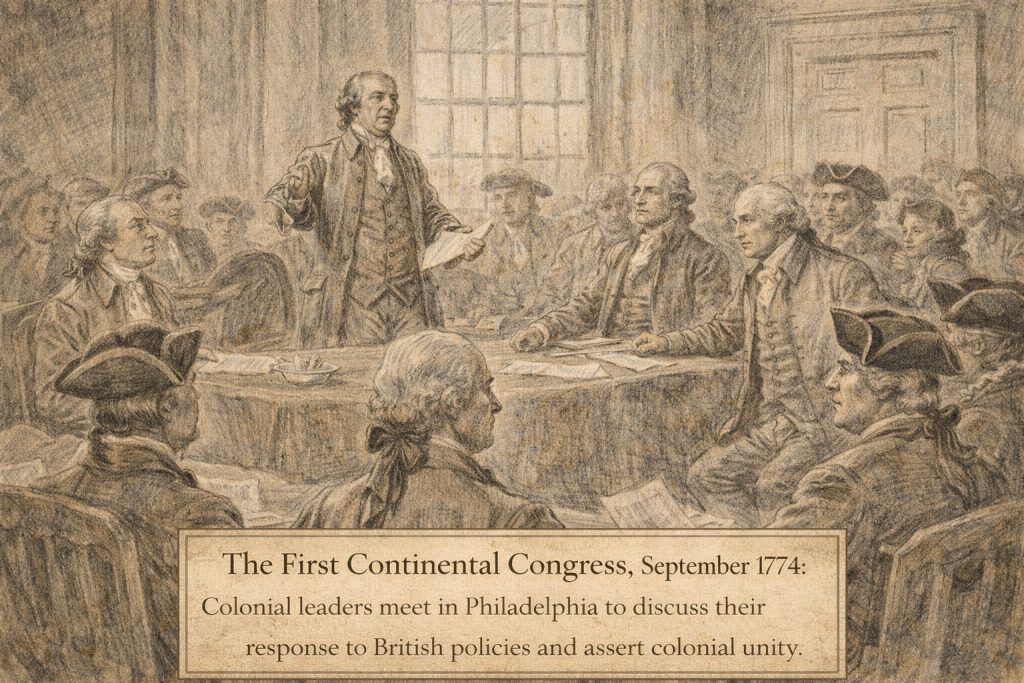
One of the most important outcomes of the Intolerable Acts was the creation of the First Continental Congress.
What was it?
- A meeting of representatives from 12 of the 13 colonies
- Held in Philadelphia in 1774
What did they do?
- Discussed how to respond to Britain
- Agreed to boycott British goods
- Sent a message to King George III
Why was this important?
It showed that the colonies could:
- Work together
- Make decisions as a group
- Stand up to British authority
13. Boycotts and Resistance
The Continental Congress encouraged colonists to:
- Stop buying British goods
- Support local products
- Resist unfair laws
Why were boycotts effective?
They:
- Hurt British businesses
- Put pressure on Parliament
- Allowed colonists to take action without violence
14. Tensions Continue to Rise
Despite these efforts, Britain did not back down.
Instead, tensions increased:
- More troops were sent
- More control was enforced
- Trust between the colonies and Britain broke down
15. From Protest to Preparation
Colonists began to prepare for the possibility of conflict.
What did they do?
- Formed militias
- Stored weapons and supplies
- Trained for defense
They hoped to avoid war—but they wanted to be ready.
16. Why the Intolerable Acts Were a Turning Point
The Intolerable Acts were a major turning point because they:
1. United the colonies
Colonies began working together in new ways
2. Increased resistance
More colonists became involved in protests
3. Weakened trust
Colonists lost faith in British leadership
17. A Miscalculation by Britain
Britain believed harsh punishment would:
- Restore order
- Discourage rebellion
Instead, it:
- Strengthened colonial unity
- Increased resistance
- Moved the colonies closer to revolution
18. Could Things Have Turned Out Differently?
It’s worth asking:
Could the conflict have been avoided?
Maybe—if:
- Britain had listened to colonial concerns
- Colonists had found other ways to protest
- Both sides had been willing to compromise
But by 1774, emotions were high, and trust was low.
19. The Road to Revolution
The Intolerable Acts set the stage for what came next.
In 1775:
- Fighting broke out at Lexington and Concord
- The American Revolution officially began
20. A Final Thought
The Intolerable Acts were meant to divide and control the colonies.
Instead, they:
- Brought people together
- Inspired cooperation
- Strengthened the desire for independence
They remind us that:
- Actions can have unexpected consequences
- Unity can grow in difficult times
- People will stand together when they feel their rights are threatened
Reflection Questions
- Why did Britain pass the Intolerable Acts?
- Which of the acts do you think was the harshest? Why?
- How did the Intolerable Acts bring the colonies together?
- Do you think Britain made a mistake in how it responded to the Boston Tea Party? Explain your reasoning.
