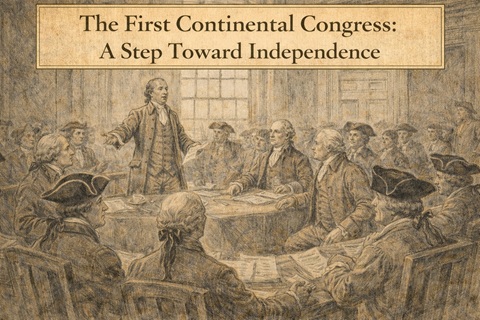
Imagine thirteen separate groups of people, each with its own government, traditions, and concerns. They live along the eastern edge of North America, and although they share some similarities, they do not always agree with one another. Now imagine these groups coming together for the first time to solve a major problem that affects them all.
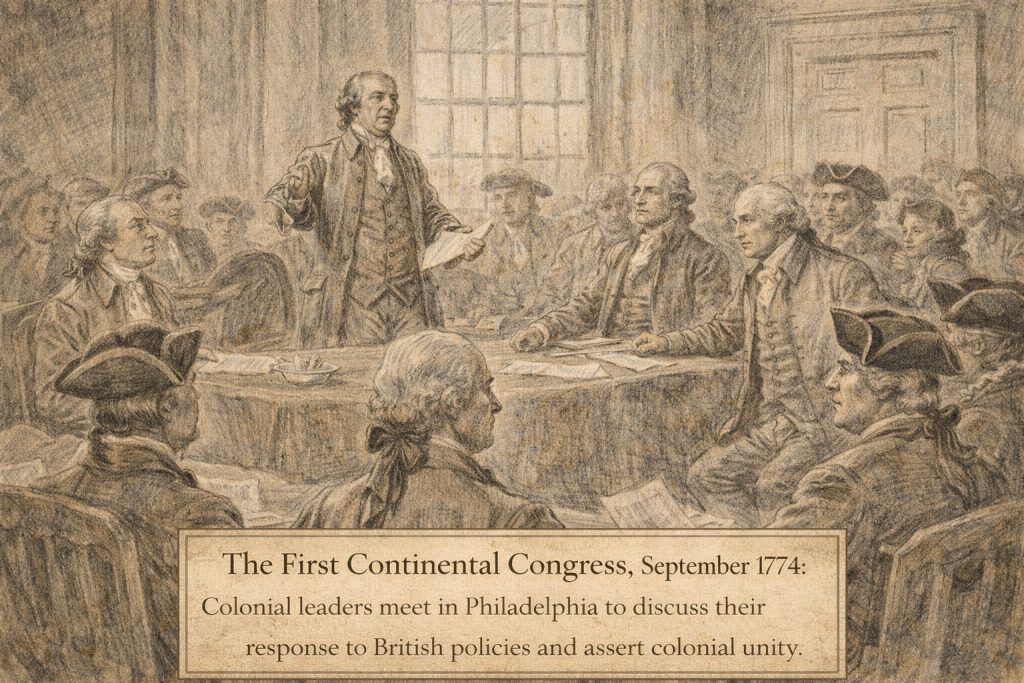
That is exactly what happened in 1774 when representatives from twelve of the thirteen American colonies met in Philadelphia for what became known as the First Continental Congress.
This meeting was a turning point. It did not declare independence. It did not start a war. But it did something just as important—it brought the colonies together and set them on a path toward unity and, eventually, independence.
1. Why Was the First Continental Congress Needed?
To understand why the Congress met, we need to look at the events leading up to it.
Growing tension with Britain
After the French and Indian War, Britain began to tighten control over the colonies. It passed laws and taxes such as:
- The Stamp Act
- The Townshend Acts
- The Tea Act
Colonists were upset because:
- They had no representation in Parliament
- They believed their rights were being ignored
The Intolerable Acts (1774)
Everything changed after the Boston Tea Party.
In response, Britain passed the Intolerable Acts, which:
- Closed Boston Harbor
- Limited self-government in Massachusetts
- Increased British control
These laws were meant to punish Massachusetts—but they alarmed all the colonies.
A shared fear
Colonists began to think:
“If Britain can do this to Massachusetts, what’s stopping them from doing it to us?”
This fear helped push the colonies toward cooperation.
2. The Idea of Meeting Together
As tensions grew, colonial leaders realized something important:
They needed to work together.
Why?
- A single colony was not strong enough to challenge Britain
- A united group might be able to make a difference
A bold idea
Leaders proposed:
- Sending representatives from each colony
- Meeting to discuss what to do
This was a big step. The colonies had never done anything like this before.
3. Where and When Did It Happen?
The First Continental Congress met in:
- Philadelphia, Pennsylvania
- In September 1774
Philadelphia was chosen because:
- It was centrally located
- It was one of the largest and most important cities in the colonies
Who attended?
- 12 of the 13 colonies sent delegates
- Only Georgia did not participate (at first)
In total, 56 delegates attended.
4. Who Were the Delegates?
The delegates were some of the most important leaders in the colonies.
Well-known figures included:
- George Washington (Virginia)
- John Adams (Massachusetts)
- Samuel Adams (Massachusetts)
- Patrick Henry (Virginia)
- John Jay (New York)
These men brought:
- Different ideas
- Different experiences
- Different opinions
5. A Challenge: Different Views
One of the biggest challenges facing the Congress was disagreement.
Not everyone wanted the same thing
Some delegates wanted:
- Strong resistance to Britain
- Major changes
Others wanted:
- Peaceful solutions
- To remain loyal to Britain
Two general groups emerged:
1. Moderates
- Wanted compromise
- Hoped to avoid conflict
2. Radicals
- Wanted stronger action
- Believed Britain had gone too far
6. What Did They Talk About?
The delegates met for several weeks and discussed key questions:
- How should the colonies respond to British actions?
- Should they resist or compromise?
- How can they work together?
Important topics included:
- The Intolerable Acts
- Colonial rights
- Economic boycotts
- Communication between colonies
7. A Powerful Idea: Colonial Rights
One of the most important things the Congress did was to clearly state what the colonists believed.
They declared that colonists had the right to:
- Life, liberty, and property
- Representation in government
- Fair laws and trials
Why was this important?
It showed that:
- Colonists were not just complaining
- They had clear ideas about their rights
8. The Declaration of Rights and Grievances
The Congress wrote a document called the Declaration of Rights and Grievances.
What did it say?
- The Intolerable Acts were unfair
- Parliament did not have the right to tax the colonies
- Colonists deserved the same rights as British citizens
Why did this matter?
It sent a message to Britain:
“We are not rebelling—we are standing up for our rights.”
9. The Continental Association
One of the most important decisions made by the Congress was to create the Continental Association.
What was it?
A plan for a colony-wide boycott of British goods.
What did it include?
- Stop importing British goods
- Stop exporting goods to Britain
- Encourage people to support local products
Why was this powerful?
It:
- United the colonies economically
- Put pressure on British businesses
- Allowed colonists to resist without violence
10. Enforcing the Boycott
To make the boycott work, the colonies created local groups to enforce it.
These groups:
- Monitored trade
- Encouraged participation
- Punished those who broke the rules
What does this show?
The colonies were beginning to:
- Govern themselves
- Work together
- Take collective action
11. Reaching Out to the King
Even though tensions were high, the Congress still hoped to avoid war.
What did they do?
- Sent a message to King George III
- Asked him to address their concerns
What does this tell us?
At this point:
- Most colonists did not want independence
- They wanted fairness and respect
12. Preparing for the Future
The Congress made an important decision before it ended.
They agreed to:
- Meet again if Britain did not respond
This showed that:
- The Congress was not a one-time event
- The colonies were planning ahead
13. Why This Meeting Was So Important
The First Continental Congress was important for several reasons.
1. It united the colonies
For the first time:
- Colonies worked together as a group
- They made decisions together
2. It created a shared identity
Colonists began to think of themselves as:
- Americans
- Part of something bigger than their individual colonies
3. It organized resistance
The Congress:
- Coordinated boycotts
- Created systems for cooperation
- Set clear goals
14. A Step Toward Independence
Even though the Congress did not declare independence, it was a major step in that direction.
Why?
Because it:
- Challenged British authority
- Encouraged unity
- Built confidence
A growing realization
Some colonists began to think:
“If we can organize ourselves, maybe we don’t need Britain at all.”
15. Britain’s Response
Britain did not respond in the way the colonists hoped.
Instead:
- Tensions continued to rise
- More troops were sent
- Conflict became more likely
16. The Road to War
Within months of the Congress:
- Fighting broke out at Lexington and Concord (April 1775)
- The American Revolution had begun
What does this mean?
The First Continental Congress helped:
- Prepare the colonies
- Build unity
- Set the stage for what came next
17. A Turning Point in History
The First Continental Congress marked a turning point because:
- Colonies began acting as one
- Resistance became organized
- The idea of independence started to grow
18. Could Things Have Been Different?
It’s worth asking:
Could the colonies and Britain have avoided war?
Possibly—if:
- Britain had listened to colonial concerns
- Compromise had been reached
- Trust had been restored
But by 1774, the relationship was already badly damaged.
19. A Final Thought
The First Continental Congress was not about declaring independence—it was about taking the first serious step toward it.
It showed that:
- People can come together in times of crisis
- Cooperation can lead to powerful change
- Big movements often start with small steps
20. Conclusion
The First Continental Congress brought together leaders from across the colonies to face a common problem. They didn’t agree on everything, but they found ways to work together.
They:
- Declared their rights
- Organized resistance
- Planned for the future
In doing so, they created something new—a sense of unity that would eventually lead to the birth of a nation.
Reflection Questions
- Why did the colonies decide to meet in the First Continental Congress?
- What were the main disagreements among the delegates?
- Why was the Continental Association important?
- Do you think the Congress could have solved the problem without war? Why or why not?
