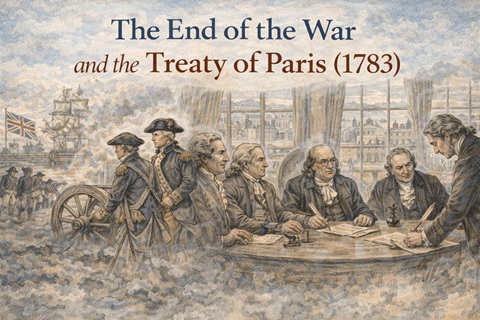
The American Revolution had been going on for many long and difficult years. By the early 1780s, people on both sides of the Atlantic Ocean were tired. Soldiers were exhausted, money was running out, and families had spent years worrying about loved ones far from home. Yet even though the war was wearing everyone down, one big question remained: How would it finally end?
The answer would come after one final major victory, months of careful negotiation, and a historic agreement known as the Treaty of Paris in 1783. This treaty officially ended the war and recognized the United States as an independent nation. But getting there was not simple. It took courage, patience, and a bit of luck.
A War Nearing Its End
By 1781, the American colonies had been fighting Great Britain for six years. At first, the British had seemed almost unbeatable. They had the strongest army and navy in the world, and they believed the rebellion would be crushed quickly.
But the war did not go as they expected.
The Continental Army, led by General George Washington, refused to give up. Even after tough winters like the one at Valley Forge, the army stayed together. At the same time, the colonists had gained an important advantage: help from foreign allies, especially France.
The French provided soldiers, supplies, money, and most importantly, a powerful navy. This support made a huge difference. Instead of fighting alone, the Americans now had one of Europe’s strongest nations on their side.
As the war continued, British leaders began to realize something troubling: winning this war was becoming more difficult, more expensive, and less popular back home in Britain.
The Final Campaign: Yorktown
The moment that truly turned the war toward its end came in 1781 at the Battle of Yorktown in Virginia.
British General Charles Cornwallis had moved his army to Yorktown, a port city along the coast. He hoped to receive support and supplies from the British navy. But this decision would prove to be a major mistake.
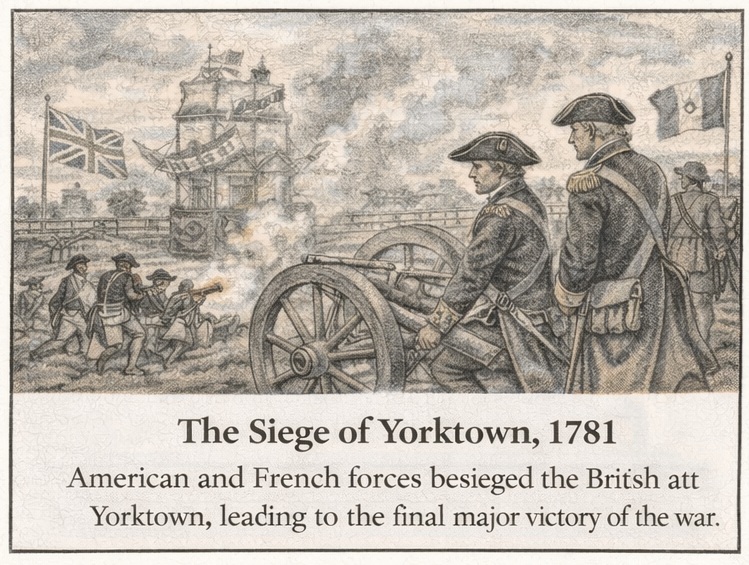
George Washington saw an opportunity. Working together with French General Rochambeau, he planned a bold attack. The plan depended on one key factor: the French navy.
In September 1781, the French fleet, led by Admiral de Grasse, arrived off the coast of Virginia. They defeated the British navy in a battle at sea and blocked any ships from reaching Cornwallis.
This meant that Cornwallis and his army were trapped.
Meanwhile, Washington and Rochambeau marched their combined American and French forces to Yorktown. They surrounded the British on land while the French navy controlled the sea. There was no escape.
For weeks, the allied forces bombarded British positions with cannons. Slowly, the British defenses weakened. Supplies ran low. Hope began to fade.
Finally, on October 19, 1781, Cornwallis surrendered.
This was a huge moment. It did not officially end the war right away, but it made one thing clear: the British could no longer win.
What Happened After Yorktown?
After the victory at Yorktown, celebrations broke out across the American colonies. It seemed like independence was finally within reach.
But the war was not over yet.
There were still British troops in other parts of North America, and no formal agreement had been made. Fighting slowed down, but leaders on both sides knew that peace talks would be necessary to officially end the war.
Back in Great Britain, news of the defeat at Yorktown shocked the government. Many members of Parliament began to question whether continuing the war was worth the cost. The war had already taken years, drained money, and caused political disagreements.
In 1782, the British government decided it was time to begin negotiations for peace.
The Road to Peace
Peace negotiations are often just as complicated as battles—and sometimes even more so.
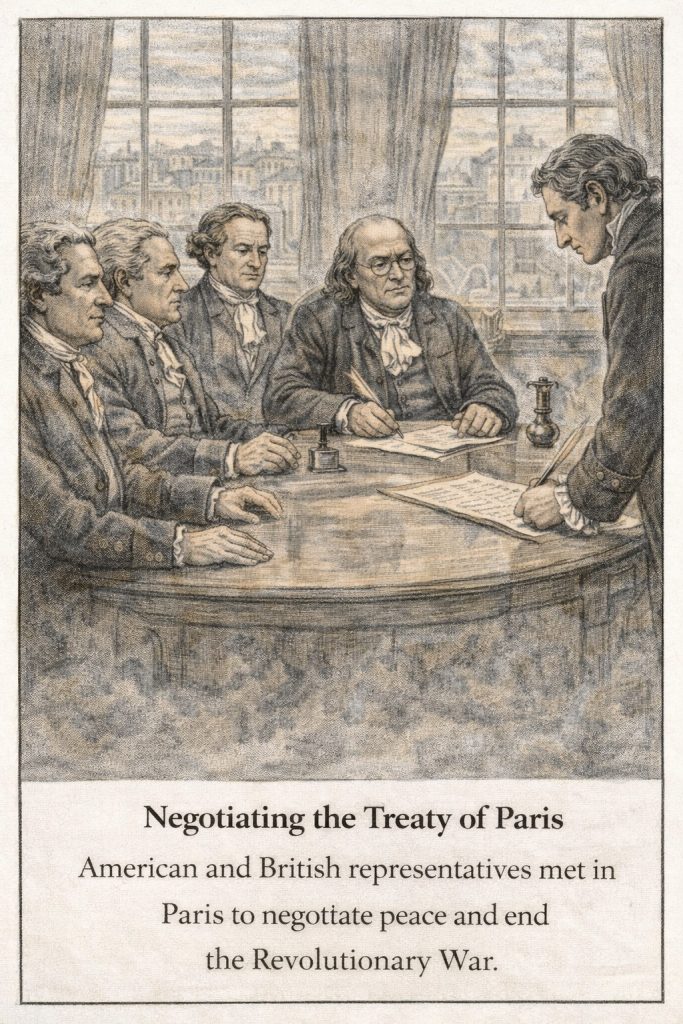
The Americans chose several important leaders to represent them in the talks. These included Benjamin Franklin, John Adams, and John Jay. All three men were experienced, intelligent, and determined to secure the best possible outcome for the new nation.
The negotiations took place in Paris, France. Even though France had been an ally of the United States, the American negotiators had to be careful. They wanted to make sure the United States would be treated as an independent country, not as a smaller partner controlled by France.
At the same time, British negotiators were trying to protect their country’s interests. They did not want to give up too much land or power.
The discussions were long and sometimes difficult. Each side had its own goals, and finding a solution that everyone could accept required compromise.
Key Issues in the Negotiations
Several important questions had to be answered before peace could be declared:
1. Would Britain recognize American independence?
This was the most important issue of all. The Americans had fought for independence, and they would not accept anything less. Britain would have to officially recognize the United States as a free and independent nation.
2. What would the new nation’s borders be?
The Americans wanted as much land as possible, especially land west of the Appalachian Mountains. This land would allow the country to grow and expand in the future.
3. What would happen to Loyalists?
Loyalists were colonists who had remained loyal to Britain during the war. Many had lost property or faced punishment. Britain wanted them to be treated fairly.
4. What about debts and trade?
There were also financial issues to settle, including debts owed by Americans to British merchants and the future of trade between the two countries.
Each of these questions required careful discussion and negotiation.
The Treaty of Paris (1783)
After months of work, an agreement was finally reached. On September 3, 1783, the Treaty of Paris was signed.
This treaty officially ended the American Revolutionary War and established the United States as an independent country.
Here are the most important parts of the treaty:
1. Independence Recognized
Great Britain officially recognized the United States of America as a free, sovereign, and independent nation. This was the goal the colonists had been fighting for all along.
2. Boundaries Established
The new nation was given generous borders. The United States would stretch from the Atlantic Ocean in the east to the Mississippi River in the west, and from Canada in the north to Florida in the south.
This was a huge amount of land, much larger than the original 13 colonies.
3. Fishing Rights
American fishermen were allowed to continue fishing in certain waters off the coast of Canada, which was important for the economy.
4. Treatment of Loyalists
The treaty stated that Loyalists should be treated fairly and that their property should be returned when possible. However, in reality, many Loyalists still faced difficulties after the war.
5. Payment of Debts
Americans agreed to repay debts owed to British merchants. This helped restore economic connections between the two nations.
Why the Treaty Was So Important
The Treaty of Paris was more than just a piece of paper—it changed the course of history.
For the first time, the United States was recognized by other countries as an independent nation. This meant that the new country could make its own laws, form its own government, and build relationships with other nations.
It also marked the end of colonial rule. The people of the United States were no longer subjects of a king. Instead, they would govern themselves.
The generous borders given to the United States also helped shape its future. With land stretching to the Mississippi River, the country had room to grow and expand.
Challenges After the War
Even though the war had ended, life was not suddenly easy for the new nation.
In fact, many challenges lay ahead.
The country was deeply in debt from the war. The government was weak, and the states often disagreed with each other. There was no strong central system in place yet.
Soldiers returned home to find farms destroyed and money scarce. Loyalists who had supported Britain often left the country or struggled to rebuild their lives.
Native American tribes, who had not been included in the treaty, faced growing pressure as American settlers moved west into their lands. This would lead to future conflicts.
In many ways, winning independence was only the beginning. The real work of building a new nation was just starting.
A New Beginning
Despite the challenges, the end of the Revolutionary War marked the beginning of something truly remarkable.
The United States was now a nation built on ideas that were new and powerful—ideas like freedom, self-government, and equality (even though those ideas would take time to fully develop for all people).
Leaders like George Washington, Benjamin Franklin, and John Adams had helped guide the country through war and into peace. Now, a new generation would take on the task of shaping the future.
The Treaty of Paris gave the United States a chance—a chance to prove that a nation built by the people, for the people, could succeed.
Looking Back
When we look back at the end of the American Revolution, it is easy to focus on the victory at Yorktown or the signing of the treaty. But it is important to remember how much effort it took to reach that point.
Years of struggle, sacrifice, and determination led to independence.
Farmers left their fields to fight. Soldiers endured harsh winters. Families supported the cause in countless ways. Allies like France risked their own resources to help.
And in the end, all of those efforts led to a moment when a new nation stood on its own for the first time.
Conclusion
The end of the American Revolution was not just about winning a war—it was about creating a new beginning.
The victory at Yorktown showed that the British could be defeated. The negotiations in Paris showed that peace could be achieved. And the Treaty of Paris made independence official.
For middle school students learning about this time, one important lesson stands out: history is shaped not only by battles, but also by decisions, cooperation, and perseverance.
The United States did not simply appear overnight. It was built step by step, through both conflict and compromise.
And it all came together in 1783, when the war ended and a new nation was born.
