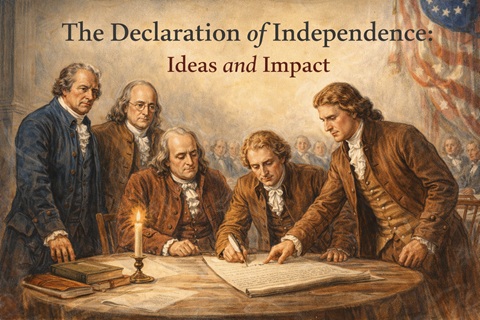
On a warm summer day in July 1776, a group of men gathered in a large room in Philadelphia. The windows were shut tight, even though the heat was rising. Outside, the streets buzzed with uncertainty. Inside, something extraordinary was about to happen.
These men were leaders from the thirteen American colonies. They had argued, debated, and worried for months. Now, they were preparing to take a bold step—one that would change history forever.
They were about to declare independence from Great Britain.
But before they could do that, they needed to answer an important question:
Why?
A Growing Conflict
To understand the Declaration of Independence, we must go back several years before 1776.
The American colonies had been part of the British Empire for a long time. At first, many colonists were proud to be British citizens. They traded with Britain, followed its laws, and relied on its protection.
But over time, problems began to grow.
After the French and Indian War, Britain was deeply in debt. To pay for the war, the British government began placing taxes on the colonies.
These included:
- The Stamp Act
- The Townshend Acts
- The Tea Act
Many colonists were angry. They believed that these taxes were unfair.
“No Taxation Without Representation”
The colonists argued that they should not be taxed unless they had a say in the government making those decisions.
This idea became known as:
“No taxation without representation.”
Colonists did not have representatives in the British Parliament. So, they felt that Parliament had no right to tax them.
At first, the colonists did not want independence. They wanted fairness. They sent petitions and letters to the king, hoping things would change.
But instead of compromise, tensions grew worse.
From Protest to War
By 1775, fighting had broken out at Lexington and Concord.
The colonies were now at war with Britain.
Still, not everyone was ready to break away completely. Some people hoped that peace could still be restored.
But as the war continued, more colonists began to believe that independence was the only solution.
A New Way of Thinking
Around this time, new ideas were spreading throughout the colonies.
Writers and thinkers were asking important questions:
- What is the purpose of government?
- Where does power come from?
- What rights do people have?
One of the most important influences was the Enlightenment, a movement that emphasized reason, logic, and individual rights.
A key thinker was John Locke.
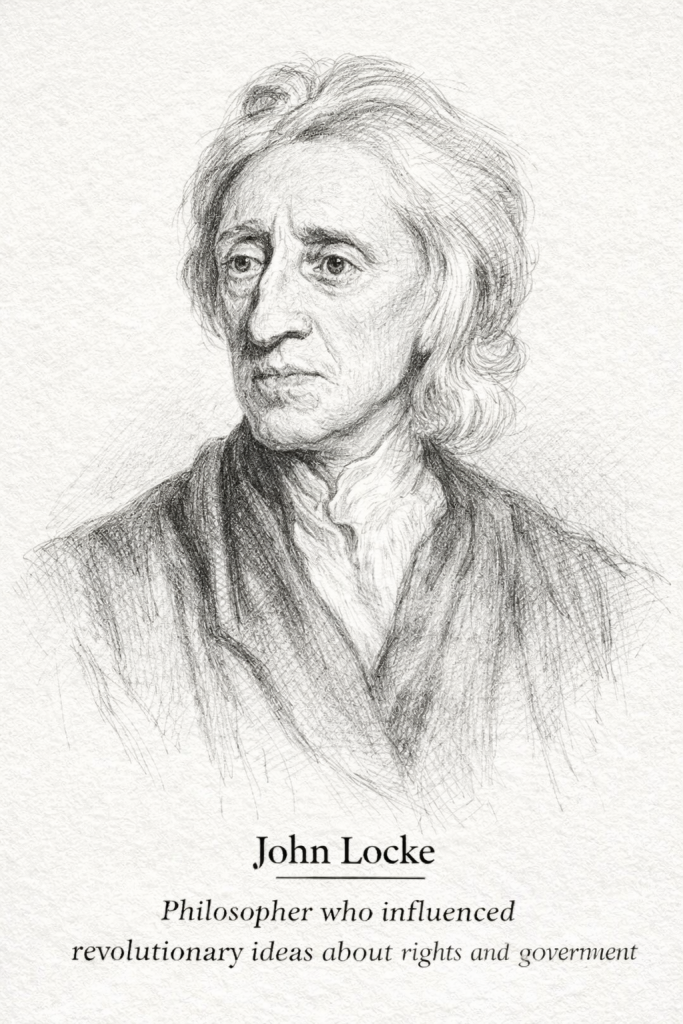
The Ideas of John Locke
John Locke believed that all people are born with certain natural rights.
These rights include:
- Life
- Liberty
- Property
He argued that governments exist to protect these rights.
What happens if a government fails?
Locke said that if a government does not protect people’s rights, the people have the right to change or even overthrow it.
This idea was powerful.
It suggested that kings did not have unlimited authority—and that the people themselves had a role in government.
The Call for Independence
In early 1776, a pamphlet called Common Sense, written by Thomas Paine, helped push the colonies toward independence.
Paine argued that it made no sense for a distant island (Britain) to rule a continent (America).
His ideas were clear, bold, and easy to understand.
Many colonists read Common Sense and began to agree:
It was time for independence.
Writing the Declaration
In June 1776, the Continental Congress decided to create a document explaining why the colonies were declaring independence.
They chose a small group to write it.
The main writer was Thomas Jefferson, with help from:
- John Adams
- Benjamin Franklin
- Roger Sherman
- Robert Livingston
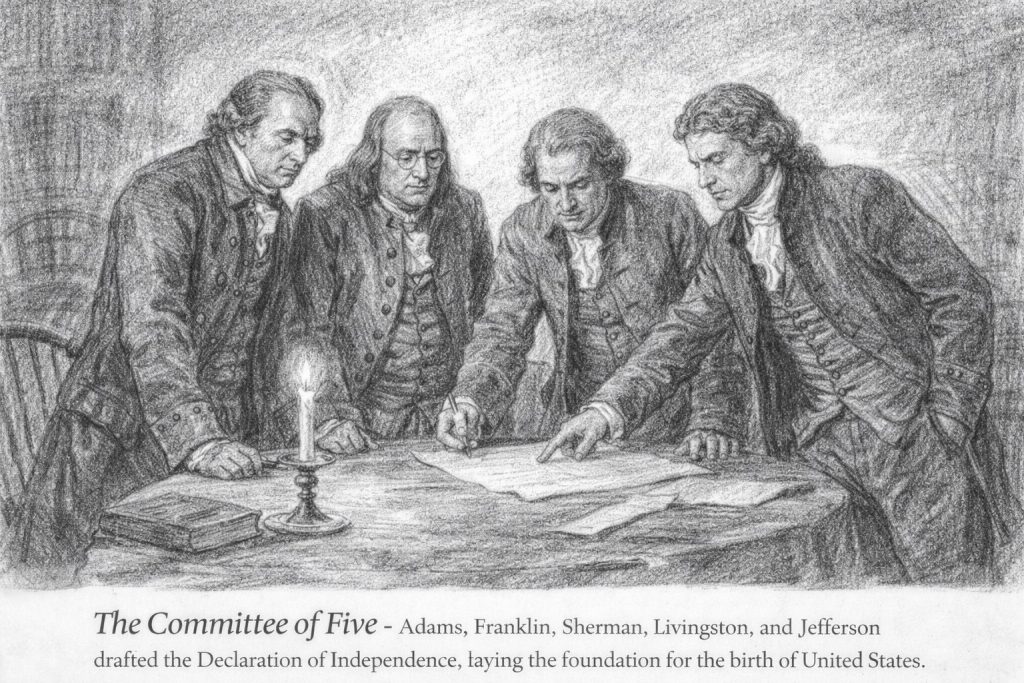
Jefferson took on the difficult task of putting the colonies’ ideas into words.
The Opening Lines
The Declaration of Independence begins with one of the most famous sentences in history:
“We hold these truths to be self-evident, that all men are created equal…”
What does this mean?
Jefferson was saying that certain truths are obvious and undeniable.
All people are:
- Equal
- Born with rights
He then listed these rights as:
- Life
- Liberty
- The pursuit of Happiness
The Purpose of Government
The Declaration goes on to explain that governments are created to protect these rights.
But governments only have power because of the people.
This idea is called:
Consent of the governed
Why is this important?
It means:
- The people give power to the government
- The government must serve the people
If it does not, the people have the right to change it.
A List of Complaints
After explaining these ideas, the Declaration lists many complaints against King George III.
These are called grievances.
They include accusations that the king:
- Imposed unfair taxes
- Took away colonial self-government
- Kept standing armies in the colonies
- Interfered with colonial laws
Why include these complaints?
The colonists wanted to show that:
- They had tried to fix the problems
- The king had ignored their concerns
This helped justify their decision to declare independence.
The Final Decision
At the end of the document, the colonies make their decision clear.
They declare that:
- The colonies are free and independent states
- They are no longer under British rule
This was a bold and dangerous move.
If they failed in the war, they could be punished as traitors.
But they believed in their cause.
July 4, 1776
On July 4, 1776, the Continental Congress approved the Declaration of Independence.
That date is now celebrated as Independence Day.
The Impact on the Colonies
The Declaration had an immediate effect.
It:
- United the colonies around a common goal
- Gave soldiers a reason to keep fighting
- Helped convince other countries, like France, to support the American cause
It turned the war into a fight for independence, not just a protest.
A Message to the World
The Declaration was not just meant for the colonists or for Britain.
It was also a message to the world.
It said:
- People have rights
- Governments must respect those rights
- Freedom is worth fighting for
These ideas spread far beyond America.
A Complicated Reality
While the Declaration spoke of equality and rights, not everyone was treated equally at the time.
Many groups were left out, including:
- Enslaved people
- Women
- Native Americans
This reminds us that while the ideas of the Declaration were powerful, the country still had work to do.
Lasting Influence
The ideas in the Declaration of Independence have had a lasting impact.
They have influenced:
- The United States Constitution
- The Bill of Rights
- Other countries seeking freedom
People around the world have looked to the Declaration as a symbol of liberty.
A Living Document
Even today, the Declaration of Independence remains important.
Its ideas continue to inspire people to think about:
- Rights
- Freedom
- Equality
It reminds us that these values must be protected and respected.
A Final Thought
The Declaration of Independence was more than just a document.
It was a statement of belief.
It said that:
- People matter
- Rights matter
- Freedom matters
And it challenged the world to take those ideas seriously.
Conclusion
In 1776, a group of leaders made a bold decision to break away from one of the most powerful empires in the world.
They explained their reasons in the Declaration of Independence, using ideas about rights, government, and freedom.
These ideas helped shape a new nation—and continue to shape the world today.
The Declaration reminds us that history is not just about events, but about ideas—and the power those ideas have to change the world.
Reflection Questions
- What were the main ideas expressed in the Declaration of Independence?
- Why did the colonists believe they had the right to declare independence?
- How did the ideas of John Locke influence the Declaration?
- Why is the Declaration still important today?
