The battlefield was quiet for a moment.
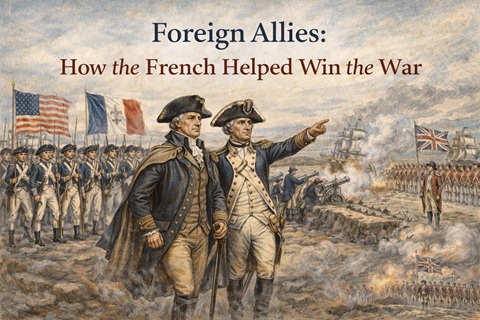
Across a wide stretch of land in Virginia, American and French soldiers stood side by side, their uniforms different but their purpose the same. Cannons were lined up. Flags fluttered in the breeze. In the distance, British troops waited, surrounded and running out of options.
It was 1781, near a place called Yorktown, and something remarkable had happened.
The American colonies were no longer fighting alone.
A powerful ally—France—had joined them.
And together, they were about to win the war.
A War That Seemed Impossible to Win
When the American Revolution began in 1775, the colonies faced a huge challenge.
They were fighting Great Britain, one of the strongest nations in the world.
The British had:
- A large, well-trained army
- A powerful navy
- Plenty of money and supplies
The American colonies had:
- A smaller, less experienced army
- Limited weapons and supplies
- Very little money
At first, many people believed the colonies had little chance of winning.
Even George Washington knew how difficult the situation was. His army struggled with shortages, harsh conditions, and repeated setbacks.
If the colonies were going to succeed, they would need help.
Why France Was Interested
France was not just any country—it was one of Britain’s biggest rivals.
For years, France and Britain had competed for power and territory around the world.
In fact, they had recently fought each other in the French and Indian War, which ended in 1763. Britain had won that war, and France had lost much of its land in North America.
France had never forgotten that defeat.
A chance for revenge
When the American colonies began fighting Britain, France saw an opportunity.
If the colonies could weaken Britain, it would benefit France.
But France was cautious.
They did not want to support the colonies unless they were sure the Americans had a real chance of winning.
Secret Support Begins
At first, France did not openly join the war.
Instead, they helped in secret.
They sent:
- Weapons
- Gunpowder
- Supplies
These supplies were extremely important.
Without them, the Continental Army might not have been able to continue fighting.
A risky decision
Helping the colonies was risky for France.
If Britain discovered what they were doing, it could lead to another war between the two countries.
Still, France continued to provide support.
The Turning Point: Saratoga
Everything changed in 1777.
That year, a major battle took place at Saratoga, in New York.
What happened at Saratoga?
British General Burgoyne had a plan to divide the colonies.
But American forces, led by General Horatio Gates and supported by leaders like Benedict Arnold, surrounded and defeated the British army.
Burgoyne was forced to surrender.
Why was this important?
The victory at Saratoga showed the world something important:
The Americans could win.
For France, this was the proof they had been waiting for.
France Joins the War
In 1778, France made a bold decision.
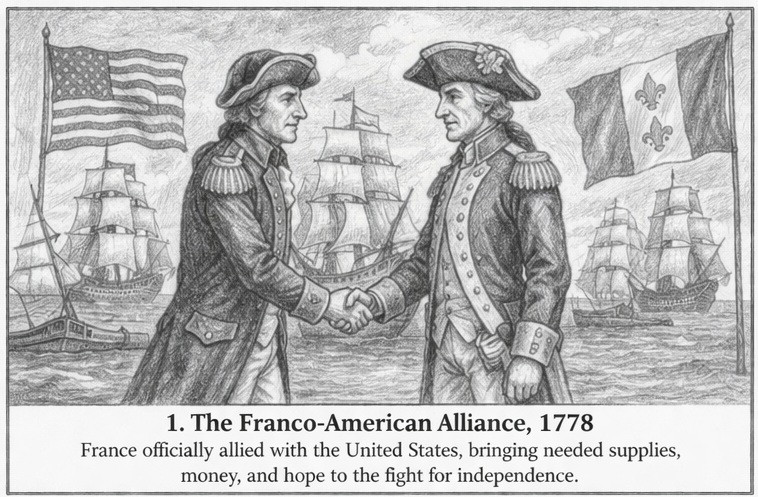
They officially became an ally of the United States.
What did this mean?
France agreed to:
- Recognize the United States as an independent nation
- Provide military support
- Fight against Britain
This changed the war in a major way.
Now, Britain was not just fighting the colonies—it was fighting France too.
The Power of the French Navy
One of the biggest advantages France brought was its navy.
The British navy had been one of their greatest strengths.
But now, they faced a serious challenge at sea.
Why was the navy so important?
Control of the sea meant:
- Moving troops and supplies
- Blocking enemy forces
- Protecting ports
With the French navy involved, Britain could no longer dominate the oceans as easily.
French Soldiers Join the Fight
France also sent soldiers to help the American cause.
One of the most important French leaders was General Rochambeau.
Working together
At first, cooperation between the American and French forces was not always easy.
They spoke different languages and had different military traditions.
But over time, they learned to work together.
They shared:
- Plans
- Resources
- A common goal
The Marquis de Lafayette
One of the most famous French figures in the American Revolution was the Marquis de Lafayette.
Who was Lafayette?
- A young French nobleman
- A volunteer in the American army
- A close friend of George Washington
Why was he important?
Lafayette:
- Helped strengthen the connection between France and the colonies
- Fought alongside American troops
- Advised Washington
He became a symbol of friendship between the two nations.
A Global War
Once France joined the fight, the war became much bigger.
It was no longer just a conflict in North America.
What changed?
Britain now had to fight:
- In the American colonies
- In Europe
- In the Caribbean
- In other parts of the world
This stretched British resources thin.
They could not focus all their attention on the American colonies anymore.
The Road to Yorktown
By 1781, the war had gone on for several years.
Both sides were tired.
But Washington and his French allies saw an opportunity.
The British move
British General Cornwallis moved his army to Yorktown, Virginia.
He believed he could be supported by the British navy.
A bold plan
Washington and Rochambeau decided to trap Cornwallis.
They would:
- March their armies south
- Surround the British on land
- Use the French navy to block escape by sea
The French Navy Blocks the Escape
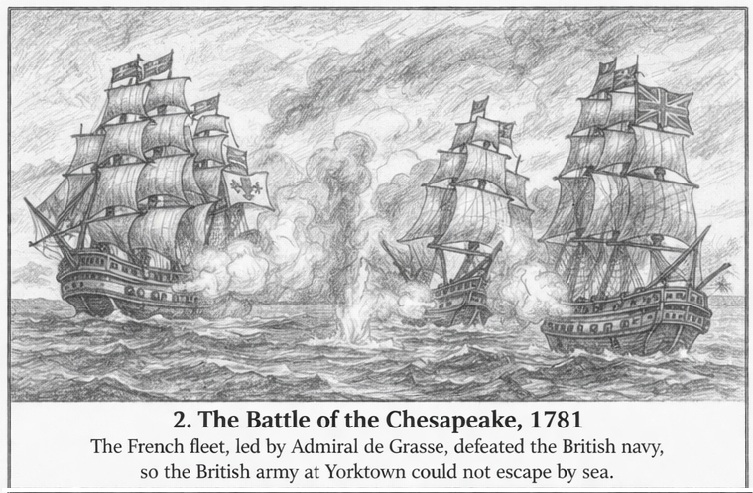
The French navy, led by Admiral de Grasse, played a crucial role.
What did they do?
They defeated the British navy in a battle off the Virginia coast.
This meant:
- The British could not escape by sea
- They could not receive reinforcements
Cornwallis was trapped.
The Siege of Yorktown
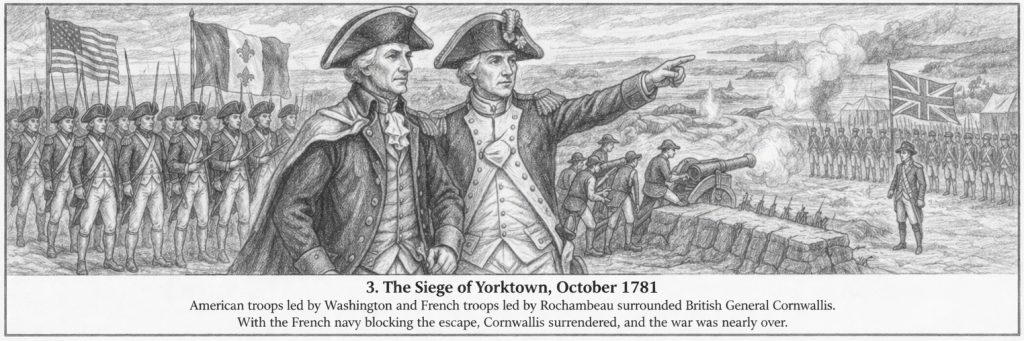
American and French forces surrounded Yorktown.
For weeks, they:
- Fired cannons
- Dug trenches
- Closed in on the British army
The situation became hopeless for the British.
The Final Surrender
In October 1781, Cornwallis surrendered.
It was a major victory.
Why was this important?
The surrender at Yorktown effectively ended the war.
Britain soon began negotiations to make peace.
The United States had won its independence.
Could America Have Won Without France?
This is an important question.
Many historians believe that without French help, the colonies might not have won the war.
Why?
Because France provided:
- Supplies when the army needed them most
- Soldiers to strengthen the fight
- A navy that helped trap the British at Yorktown
Each of these contributions was critical.
A Lasting Friendship
The alliance between the United States and France created a lasting connection.
Although the relationship would change over time, the support France gave during the Revolution was never forgotten.
The Bigger Idea
The story of France’s role in the American Revolution shows something important:
Sometimes, success depends on teamwork.
The colonies could not do everything alone.
They needed help—and they accepted it.
A Final Thought
When we think about the American Revolution, we often focus on figures like George Washington and the Continental Army.
But behind the scenes—and sometimes on the battlefield—France played a key role.
Their support helped turn a struggling rebellion into a successful fight for independence.
Conclusion
The American Revolution was not won by the colonies alone.
With the help of France, the balance of power changed.
French supplies, soldiers, and naval strength gave the Americans the support they needed at the most critical moments.
At Yorktown, that partnership led to victory.
And that victory led to the birth of a new nation.
Reflection Questions
- Why was France willing to help the American colonies?
- What role did the Battle of Saratoga play in gaining French support?
- How did the French navy contribute to the victory at Yorktown?
- Do you think the colonies could have won without France? Why or why not?
