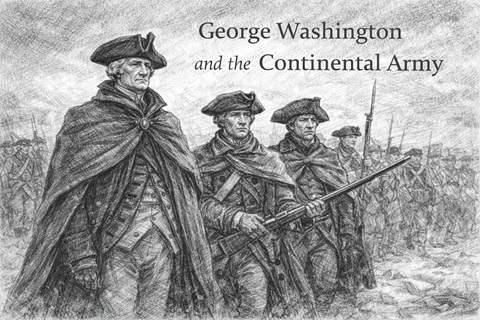
The wind whipped across the open fields as a tall man on horseback rode slowly along a line of soldiers. His blue coat stood out against the gray sky, and his face was calm but serious. He paused, looking at the men before him—farmers, laborers, and young boys who had never expected to become soldiers.
They were cold. They were tired. Some didn’t even have proper shoes.
And yet, they stood there, waiting.
The man on horseback was George Washington, and the army before him—the Continental Army—was all that stood between the American colonies and defeat.
What happened next would shape the future of a new nation.
A Reluctant Beginning
When fighting first broke out in 1775 at Lexington and Concord, the colonies did not yet have a true army. Instead, they had groups of local militia—citizens who took up arms when needed.
But as the conflict grew, colonial leaders realized something important:
They needed a unified force.
In June 1775, during the Second Continental Congress in Philadelphia, the delegates made a critical decision. They created the Continental Army and chose George Washington to lead it.
Washington did not ask for the job. In fact, he knew how difficult it would be.
He understood that he would be leading:
- An untrained army
- With limited supplies
- Against one of the most powerful military forces in the world
Still, he accepted the responsibility.
The Army Takes Shape
When Washington arrived near Boston, where colonial forces were surrounding British troops, he saw immediately that the army needed help.
The soldiers were brave—but they lacked:
- Organization
- Discipline
- Uniform training
Many men came and went as they pleased. Some had no proper weapons. Others had never fired a musket before.
Washington knew that if they were going to win, they needed to become a real army.
Building Discipline and Unity
Washington began by bringing order to the chaos.
He:
- Established clear rules
- Organized the soldiers into units
- Insisted on regular training
He also worked to create a sense of unity.
Before this, soldiers often thought of themselves as being from a particular colony—Virginia, Massachusetts, or New York.
Washington wanted them to think of themselves as something new:
Americans.
This idea was powerful. It helped the soldiers see that they were part of something bigger than themselves.
A Difficult War Begins
Even with Washington’s leadership, the Continental Army faced enormous challenges.
The British army was:
- Well-trained
- Well-equipped
- Experienced
The Continental Army was:
- Undersupplied
- Inexperienced
- Often outnumbered
At times, it seemed impossible that they could succeed.
The Importance of Strategy
Washington understood something very important:
He did not need to win every battle.
He just needed to keep the army alive.
If the Continental Army survived, the colonies still had hope. If it was destroyed, the fight for independence would be over.
This idea shaped Washington’s strategy.
Instead of always attacking, he often:
- Avoided large, risky battles
- Retreated when necessary
- Looked for the right moments to strike
Some people criticized him for this. They wanted bold victories.
But Washington knew that patience could be just as powerful as courage.
A Turning Point: The Battle of Trenton
One of Washington’s most famous decisions came in the winter of 1776.
The situation was desperate.
The Continental Army had suffered several defeats. Many soldiers were preparing to leave when their enlistments ended. Morale was low.
Washington needed a victory—and fast.
A bold plan
On Christmas night, Washington led his army across the icy Delaware River.
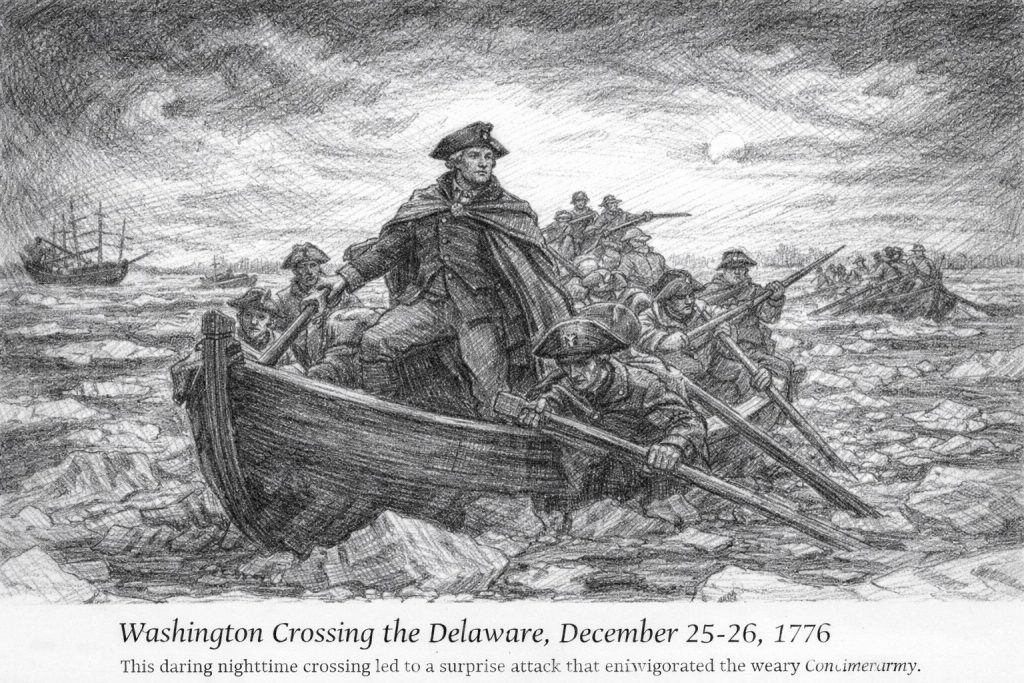
It was dangerous:
- The weather was freezing
- Ice filled the river
- The crossing was slow and difficult
But Washington pressed on.
The surprise attack
On the morning of December 26, 1776, Washington’s army attacked British-allied Hessian soldiers in Trenton.
The enemy was caught off guard.
The result was a clear victory.
Why this mattered
The victory at Trenton:
- Boosted morale
- Encouraged soldiers to stay
- Proved that the Continental Army could win
It was exactly what the army needed.
Hardships at Valley Forge
Not all of Washington’s victories came on the battlefield.
Some of his greatest challenges came during the winter of 1777–1778 at a place called Valley Forge.
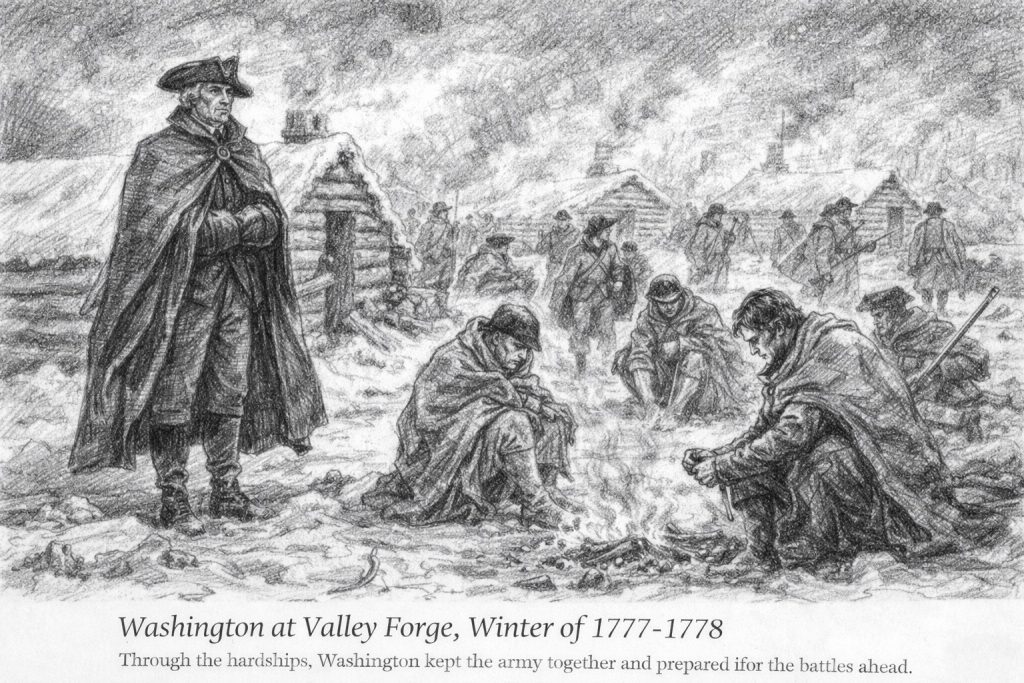
A harsh winter
At Valley Forge:
- Food was scarce
- Clothing was worn out
- Supplies were limited
Some soldiers had no shoes, leaving bloody footprints in the snow.
Many became sick.
Some died.
Why didn’t they leave?
Despite these hardships, many soldiers stayed.
Why?
Because of:
- Their belief in the cause
- Their loyalty to one another
- Their trust in Washington
Washington remained with his army, sharing their struggles. His leadership inspired the men to endure.
Training and Transformation
During the winter at Valley Forge, something important happened.
A Prussian officer named Baron von Steuben arrived to help train the army.
What did he do?
Von Steuben:
- Taught soldiers how to drill and march
- Improved discipline
- Introduced new training methods
The result
By the time spring arrived:
- The Continental Army was stronger
- More organized
- Better prepared for battle
Valley Forge, though difficult, became a turning point.
Fighting for Survival
Throughout the war, Washington continued to face challenges.
He had to:
- Manage limited supplies
- Deal with disagreements among leaders
- Keep the army together
There were times when victory seemed far away.
But Washington never gave up.
The Final Campaign: Yorktown
By 1781, the war had gone on for years.
Both sides were tired.
But Washington saw an opportunity.
A combined effort
With help from French allies, Washington moved his army to Yorktown, Virginia.
There, they surrounded British General Cornwallis’s army.
The siege
For weeks:
- Cannons fired
- Trenches were dug
- Pressure built
The British were trapped.
The surrender
In October 1781, Cornwallis surrendered.
It was a decisive victory.
Why Yorktown mattered
The victory at Yorktown effectively ended the war.
The colonies had won their independence.
The Strength of Leadership
George Washington’s leadership was one of the most important factors in the success of the Continental Army.
He was not perfect.
He made mistakes.
But he showed qualities that mattered most:
- Determination
- Patience
- Courage
The Power of the Continental Army
The Continental Army was not the strongest army in the world.
But it had something just as important:
Commitment.
These soldiers fought for:
- Their homes
- Their rights
- Their future
A New Nation Begins
After the war ended, Washington did something remarkable.
He stepped down as commander.
He returned to his home instead of trying to take power.
This showed that:
- The new nation would be based on freedom
- Power would belong to the people
A Final Thought
The story of George Washington and the Continental Army is not just about battles.
It is about:
- Leadership in difficult times
- People working together
- Believing in something bigger than yourself
Conclusion
From the early days of confusion and struggle to the final victory at Yorktown, George Washington and the Continental Army faced incredible challenges.
They:
- Built an army from almost nothing
- Survived harsh winters and difficult battles
- Never gave up
In the end, their perseverance helped create a new nation.
And it all began with a group of ordinary people—and one determined leader—who believed that freedom was worth fighting for.
Reflection Questions
- Why was George Washington a good choice to lead the Continental Army?
- Why was the victory at Trenton so important?
- What made Valley Forge a turning point?
- How did the victory at Yorktown help end the war?
