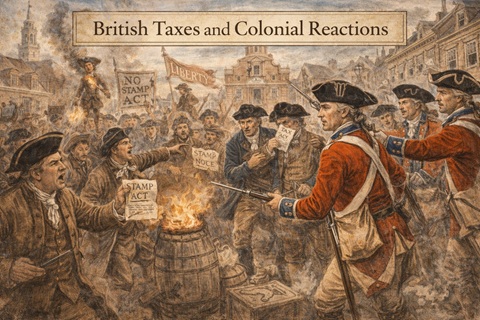
Imagine waking up one morning and discovering that you now have to pay extra money for things you use every day—paper, newspapers, cards, even tea. Now imagine that the people making these rules live far away, and you have no say in their decisions.
That’s exactly how many American colonists felt in the years after the French and Indian War. During this time, a series of British tax laws—starting with the Stamp Act and continuing through the Tea Act—sparked anger, protests, and growing resistance.
These taxes didn’t just cost money. They raised important questions about fairness, rights, and power—questions that would eventually lead to the American Revolution.
Let’s explore what happened.
1. Why Did Britain Start Taxing the Colonies?
To understand the taxes, we first need to understand the situation Britain was in after the French and Indian War (1754–1763).
Britain’s Problem:
- The war had been very expensive
- Britain was left with huge debt
- It now had more land to defend in North America
Britain’s Solution:
British leaders believed the colonies should help pay for:
- The cost of the war
- The cost of protecting the colonies
From Britain’s point of view, this seemed fair. After all, the war had helped protect the colonies from French threats.
But the colonists saw things differently.
2. The Sugar Act (1764): A First Step
Before the Stamp Act, Britain passed the Sugar Act in 1764.
What did it do?
- Placed taxes on imported goods like sugar and molasses
- Strengthened enforcement against smuggling
Why did colonists dislike it?
- It affected merchants and trade
- It showed Britain was becoming more serious about collecting taxes
Although the Sugar Act did not create huge protests, it was an early warning sign.
3. The Stamp Act (1765): A Major Turning Point
The real conflict began with the Stamp Act of 1765.
What was the Stamp Act?
It required colonists to pay a tax on printed materials, including:
- Newspapers
- Legal documents
- Licenses
- Playing cards
These items had to carry an official stamp showing the tax had been paid.
Why was this different?
This was the first direct tax on everyday items inside the colonies.
4. Colonial Reaction: “No Taxation Without Representation”
The Stamp Act caused immediate anger.
Colonists argued:
- They had no representatives in Parliament
- Therefore, Parliament should not tax them
This idea became the famous slogan:
“No taxation without representation.”
What did this mean?
Colonists believed:
- Taxes should only be approved by their own elected assemblies
- Being taxed by a distant government was unfair
This wasn’t just about money—it was about rights and fairness.
5. Protests and Resistance
The Stamp Act led to widespread protests.
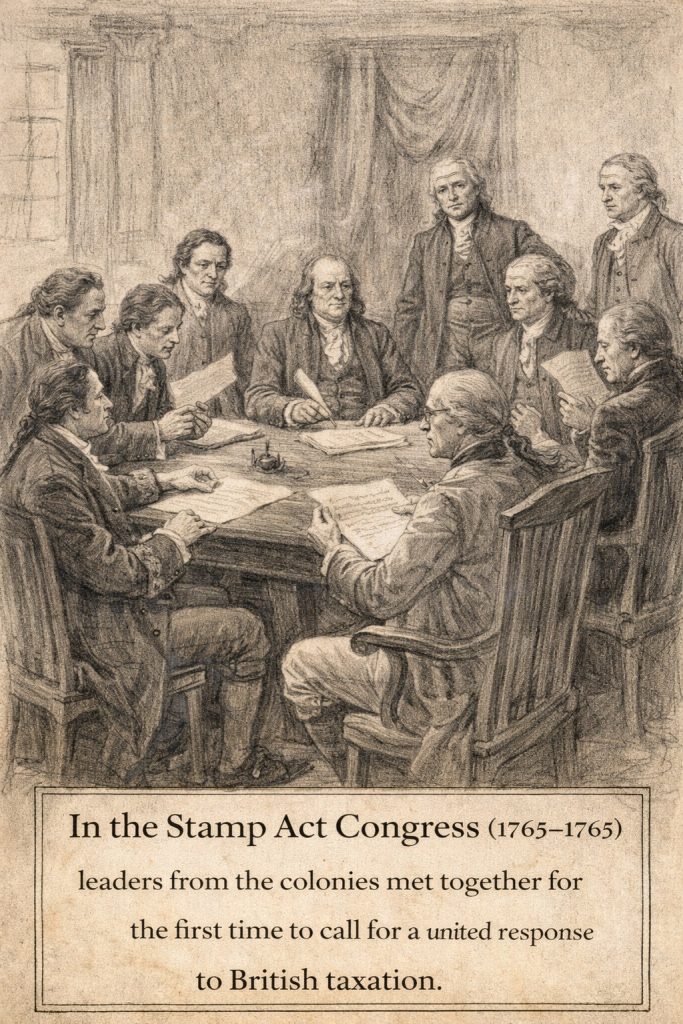
1. The Stamp Act Congress
- Representatives from several colonies met in 1765
- They wrote a petition declaring the tax unfair
This was one of the first times the colonies worked together.
2. Boycotts
- Colonists refused to buy British goods
- Merchants stopped importing British products
This hurt British businesses and put pressure on Parliament.
3. The Sons of Liberty
A group called the Sons of Liberty played a key role.
They:
- Organized protests
- Spread ideas about resistance
- Sometimes used intimidation against tax collectors
4. Violence and Pressure
- Tax collectors were threatened
- Effigies (fake figures) were burned
- Some officials resigned rather than enforce the law
6. Britain Responds: Repeal and Warning
Because of colonial resistance and pressure from British merchants, Parliament repealed the Stamp Act in 1766.
Colonists celebrated—but there was a catch.
At the same time, Britain passed the Declaratory Act.
What did it say?
Parliament declared it had the right to:
“Make laws… to bind the colonies in all cases whatsoever.”
Why does this matter?
Even though the Stamp Act was gone, Britain made it clear:
- It still believed it had full authority over the colonies
The conflict was far from over.
7. The Townshend Acts (1767): More Taxes
Soon after, Britain passed a new set of taxes called the Townshend Acts.
What did they tax?
- Glass
- Paper
- Paint
- Lead
- Tea
What was different this time?
These were indirect taxes (on imports), which Britain hoped would be less controversial.
But colonists still objected.
8. Colonial Reaction: Boycotts Return
Colonists responded in familiar ways:
Non-Importation Agreements
- Colonists agreed not to buy British goods
- Women played an important role by making homemade goods
Increased Unity
- Colonies communicated and coordinated their resistance
- Groups like the Daughters of Liberty supported the boycott efforts
9. Rising Tensions in Boston
Boston became a center of resistance.
Why?
- Strong anti-British feelings
- Active protest groups
- Heavy British presence
To maintain order, Britain sent soldiers to Boston.
Why was this a problem?
- Colonists saw it as a threat
- Tensions between soldiers and civilians grew
10. The Boston Massacre (1770)
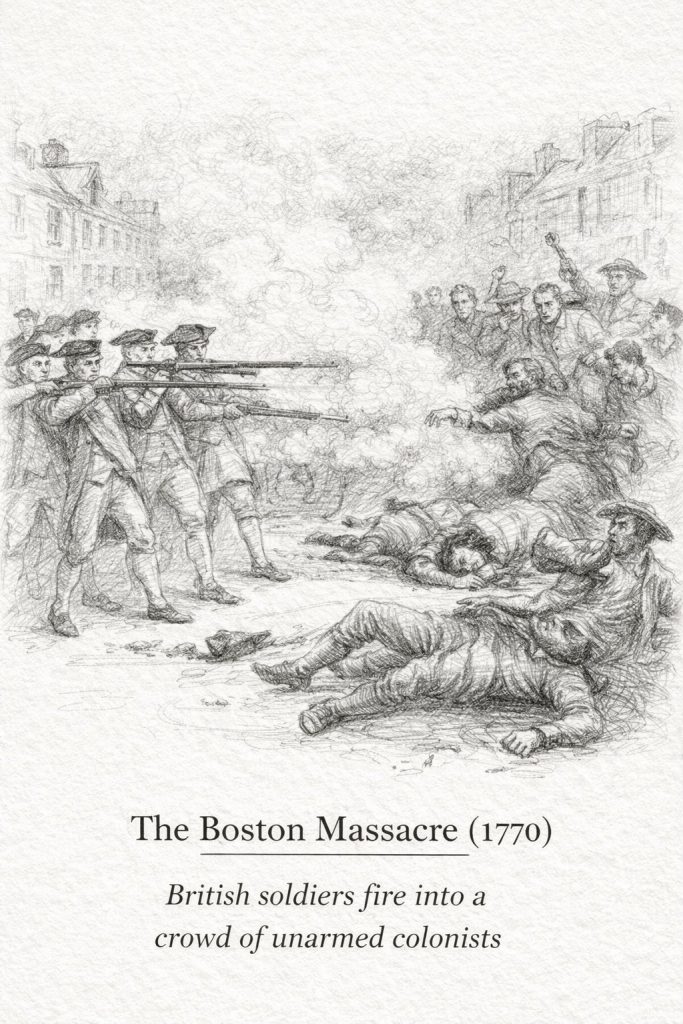
On March 5, 1770, tensions exploded.
What happened?
- A crowd of colonists confronted British soldiers
- The situation became chaotic
- Soldiers fired into the crowd
Result:
- Five colonists were killed
Why was this important?
Colonial leaders used the event as propaganda:
- It was described as a brutal attack
- It increased anger toward Britain
11. Britain Backs Down (Partially)
In response to ongoing protests:
- Britain repealed most of the Townshend taxes
- BUT kept a tax on tea
Why keep the tea tax?
To show that Parliament still had the right to tax the colonies.
12. A Temporary Calm
For a few years, tensions cooled slightly.
But the main issue remained unresolved:
- Britain believed it had authority
- Colonists believed they had rights
This disagreement would soon flare up again.
13. The Tea Act (1773): A New Problem
In 1773, Britain passed the Tea Act.
What did it do?
- Gave the British East India Company control over tea sales in the colonies
- Made tea cheaper—but still taxed
Why was this controversial?
Even though tea was cheaper, colonists saw the law as:
- A trick to get them to accept the tax
- An unfair advantage for a British company
14. Colonial Reaction: Rejecting the Tea
Colonists refused to accept the tea.
What did they do?
- Turned away ships carrying tea
- Organized protests
- Prevented tea from being unloaded
In Boston, events took a dramatic turn.
15. The Boston Tea Party (1773)
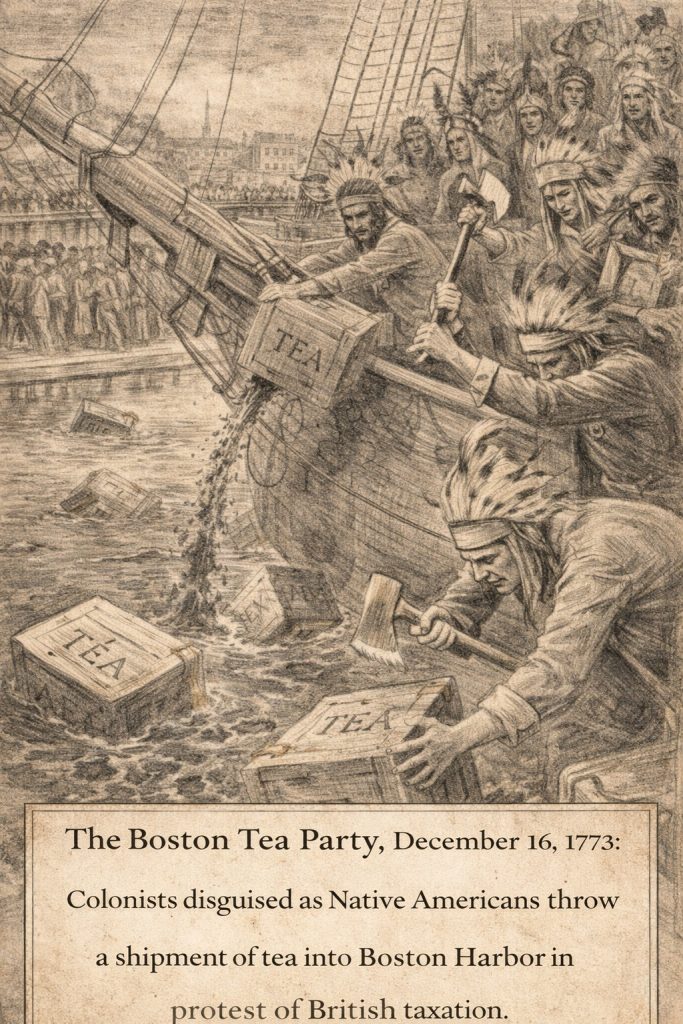
On December 16, 1773:
- A group of colonists disguised themselves (often as Mohawk Indians)
- They boarded British ships in Boston Harbor
- They dumped 342 chests of tea into the water
Why was this significant?
- It was a direct challenge to British authority
- It destroyed valuable property
- It showed colonists were willing to take bold action
16. Britain’s Reaction: The Intolerable Acts
Britain responded harshly.
The Intolerable Acts (1774) included:
- Closing Boston Harbor
- Limiting self-government in Massachusetts
- Increasing British control
Why did this backfire?
Instead of isolating Massachusetts:
- Other colonies supported Boston
- Unity among the colonies grew
17. A Pattern of Action and Reaction
From the Stamp Act to the Tea Act, a clear pattern developed:
Britain:
- Imposed taxes
- Asserted authority
Colonists:
- Protested
- Boycotted
- Resisted
Each side believed it was right.
But neither side was willing to give in.
18. Why These Taxes Mattered So Much
It might seem like this conflict was just about taxes—but it wasn’t.
It was really about:
- Rights – Do colonists have the same rights as British citizens?
- Representation – Should people have a say in their government?
- Power – Who has the authority to make laws?
These deeper questions made compromise difficult.
19. How This Led to Revolution
The events between 1765 and 1773 changed everything.
Colonists began to:
- Work together
- Share ideas
- Resist British authority
Britain became:
- More determined to control the colonies
- Less willing to compromise
This growing conflict led to:
- The First Continental Congress (1774)
- Increased tensions
- Eventually, armed conflict
20. A Final Thought
The Stamp Act, Townshend Acts, and Tea Act were more than just laws—they were turning points.
They showed that:
- Small policies can have big consequences
- Ideas about fairness can inspire action
- People will resist when they feel their rights are threatened
What began as a disagreement over taxes became a movement for independence.
Reflection Questions
- Why did Britain believe it had the right to tax the colonies?
- Why were colonists so upset about taxation without representation?
- Which reaction (boycott, protest, or direct action like the Boston Tea Party) do you think was most effective? Why?
- Do you think the conflict could have been resolved without war? Explain your reasoning.
