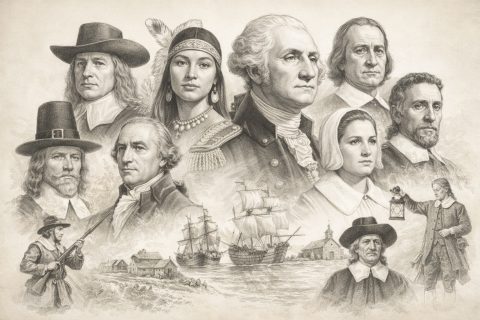
The 13 Colonies were English settlements established along the Atlantic coast of North America during the seventeenth and eighteenth centuries. Stretching from New Hampshire in the north to Georgia in the south, these colonies formed the political, cultural, and economic foundation of what would eventually become the United States.
Although each colony developed its own character, institutions, and economy, they shared a common connection to the English crown and participated in a broader Atlantic world of trade, migration, and cultural exchange. Over time, tensions between the colonies and Great Britain grew, ultimately leading to the American Revolution and the creation of a new nation.
Historians traditionally divide the thirteen colonies into three geographic and cultural regions: the New England Colonies, the Middle Colonies, and the Southern Colonies. Each region developed distinctive patterns of settlement, government, religion, and economic life.
This guide introduces the thirteen colonies and links to detailed articles exploring the history of each one.
The New England Colonies
The New England colonies were the northernmost English settlements in North America. Established primarily during the early seventeenth century, these colonies were shaped strongly by religious motivations, particularly among the Puritans who sought to build communities based on their interpretation of Christian faith.
The geography of New England—rocky soil, dense forests, and a jagged coastline—encouraged economic activities such as fishing, shipbuilding, small-scale farming, and trade. Towns tended to be closely organized communities centered around churches and town meetings, which helped foster traditions of local self-government.
The New England colonies included:
The colony of Massachusetts played an especially influential role in early American history. Founded by Puritan settlers seeking religious reform, it became one of the most populous and economically active colonies in North America. During the colonial period, the territory that later became the state of Maine remained part of Massachusetts, though separated geographically from the main body of the colony.
Not all settlers in New England agreed with the religious leadership of Massachusetts, however. Figures such as Anne Hutchinson and Roger Williams challenged Puritan authorities and helped establish colonies that emphasized religious liberty and greater tolerance.
Rhode Island, in particular, became known as one of the most religiously diverse colonies in North America.
No post found!
The Middle Colonies
The Middle Colonies occupied the region between New England and the southern plantation colonies. Because of their fertile soil, navigable rivers, and important ports, these colonies developed thriving agricultural and commercial economies.
The Middle Colonies included:
- New York
- New Jersey
- Pennsylvania
- Delaware
Unlike the more religiously homogeneous New England colonies, the Middle Colonies were marked by remarkable cultural diversity. Settlers came not only from England but also from Germany, the Netherlands, Sweden, Scotland, and other parts of Europe.
One of the most important figures in the development of this region was William Penn, a member of the Religious Society of Friends, commonly known as Quakers. Penn envisioned Pennsylvania as a place where people of many different religious traditions could live peacefully together.
Pennsylvania soon became one of the most prosperous colonies in North America. Its capital city, Philadelphia, emerged as a center of trade, printing, intellectual life, and political discussion.
The Middle Colonies also served as an important bridge between the northern and southern parts of colonial society. Their agricultural productivity earned them the nickname “the breadbasket colonies.”
No post found!
The Southern Colonies
The Southern Colonies developed a very different economic and social structure from the colonies to the north. Warm climates, long growing seasons, and fertile land made these colonies well suited to plantation agriculture.
The Southern Colonies included:
- Maryland
- Virginia
- North Carolina
- South Carolina
- Georgia
The first successful permanent English settlement in North America was established in Virginia in 1607 at Jamestown. Over time, tobacco became the dominant crop of the Chesapeake region, shaping the economy and social structure of the colony.
Further south, rice and indigo became major cash crops in South Carolina and Georgia. Plantation agriculture in these regions relied heavily on enslaved labor, which became deeply embedded in the economic system of the southern colonies.
One of the most prominent figures to emerge from the southern colonies was George Washington, who was born in Virginia and later played a central role in the struggle for American independence.
Despite their differences, the southern colonies shared political institutions with the other colonies, including colonial assemblies and traditions of representative government.
No post found!
A World of Diversity and Experiment
Taken together, the thirteen colonies represented a remarkable experiment in settlement and governance. Each colony had its own founding story, political traditions, and cultural influences.
Some colonies were founded primarily for religious reasons, such as Massachusetts and Pennsylvania. Others were established largely for economic opportunity, as in Virginia and South Carolina. Still others emerged as refuges for religious dissenters seeking freedom of conscience.
The colonies also varied widely in climate, geography, and economic activity. From the fishing villages of New England to the bustling ports of the Middle Colonies and the plantation landscapes of the South, colonial America was a complex and dynamic society.
From Colonies to a Nation
By the mid-eighteenth century, the thirteen colonies had grown dramatically in population and prosperity. Trade networks connected them to Great Britain, the Caribbean, Europe, and Africa.
At the same time, many colonists began to develop a stronger sense of identity distinct from the British Empire. Disputes over taxation, representation, and imperial authority eventually led to the outbreak of the American Revolution.
In 1776, representatives from the colonies gathered in Philadelphia and adopted the United States Declaration of Independence, formally declaring their independence from Great Britain.
The thirteen colonies thus became the original states of a new nation.
Exploring the History of Each Colony
Each of the thirteen colonies has its own fascinating history, shaped by its founders, geography, and economic development. The articles linked above explore each colony in detail—from the Puritan settlements of New England to the plantation societies of the South.
Together they tell the story of how a collection of English settlements along the Atlantic coast evolved into the foundation of the United States.